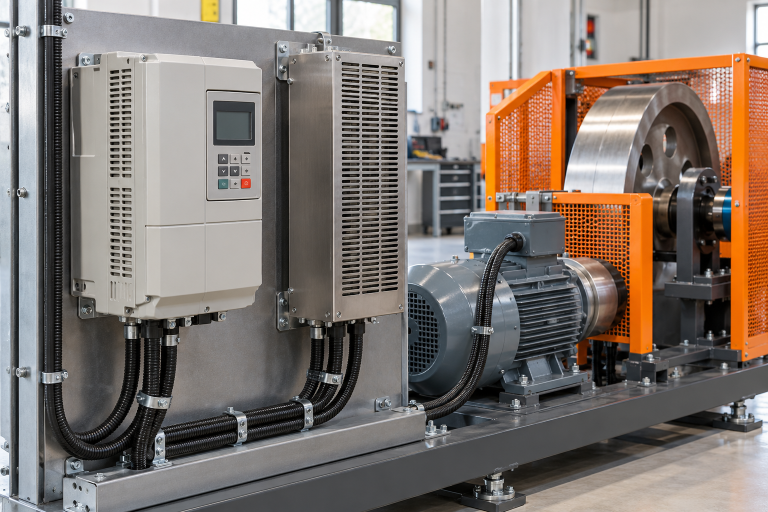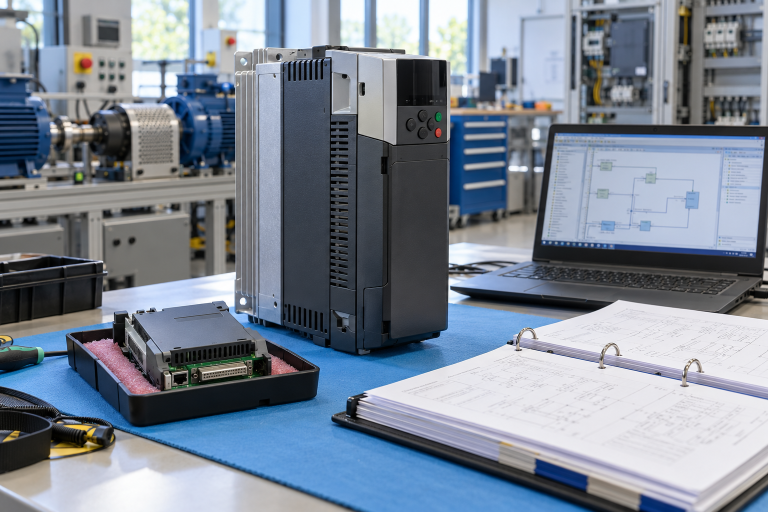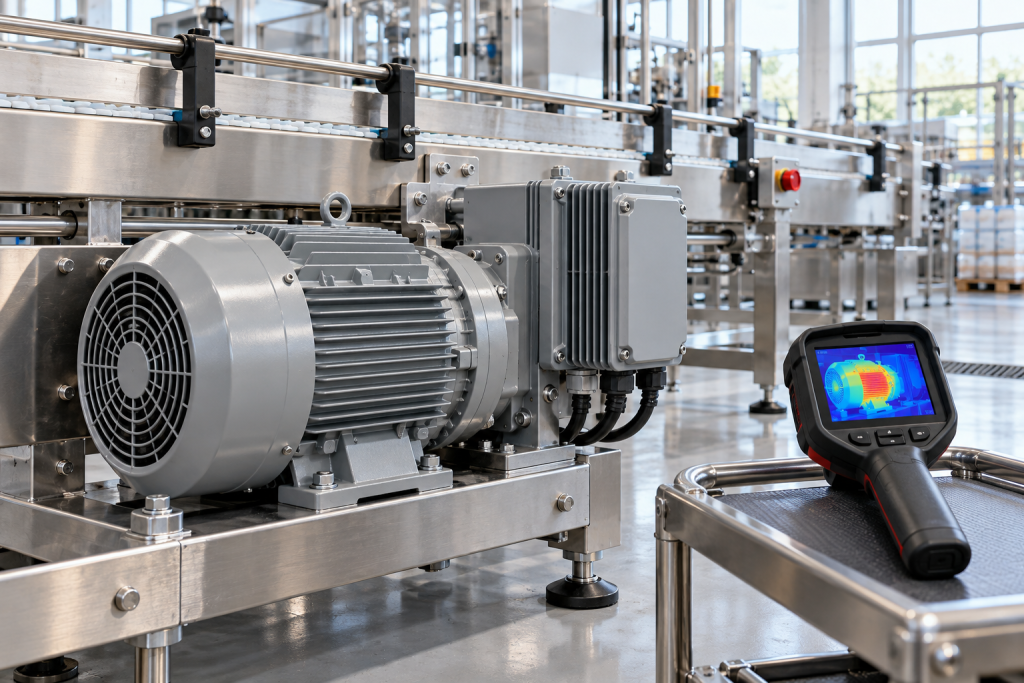
The conveyor runs after a drive replacement. Current looks reasonable, the operator clears the work order and production resumes. Yet one question may still be unanswered: what will stop the motor if its cooling deteriorates or its thermal condition becomes unacceptable?
For a Danfoss FCD 300 installation, motor thermal protection deserves its own acceptance record. A successful start proves that the machine can move under the tested conditions. It does not prove that the replacement has retained the intended protection method, warning behavior or trip response. This is a practical maintenance issue, not a newly announced vulnerability or an invented end-of-life deadline.
Begin with the protected motor
The motor nameplate and the actual application should lead the review. Record the installed motor identity, rated data, operating duty and cooling arrangement. Compare those facts with the approved commissioning record. A drive parameter archive is valuable evidence, but it may belong to an earlier motor or to a machine configuration that has since changed.
A replacement taken from another conveyor can contain settings that look familiar while describing a different load. The issue is not simply whether the drive has sufficient capacity. The protection assumptions must also match the motor and duty now in service. Where the documentation disagrees with the installation, resolve the discrepancy before accepting the configuration.
Calculated thermal behavior and measured temperature are different evidence
The Danfoss FCD 300 Design Guide describes electronic thermal relay functions and thermistor-based protection choices. It notes limitations relevant to reduced cooling and to multiple motors connected in parallel. These are different protection approaches, not interchangeable labels for a generic motor-overload feature.
An engineer reviewing a calculated thermal function needs to understand its documented assumptions. A temperature-sensor path additionally depends on the installed sensor, wiring and selected response. Neither route should be assumed effective merely because an option appears in a menu. The maintenance record should state which method the plant relies on and what evidence supports that reliance.
Do not deliberately overheat a motor to test the protection. Use the manufacturer’s approved procedures and a controlled test plan prepared by qualified personnel. Electrical isolation, stored-energy precautions and protection against unintended starting apply throughout the work.
The spare request should retain the complete type code
A catalog reference such as the FCD322PT4P66STR1D0F00T52C0 decentralized drive should not be shortened to “FCD 300 replacement” in the purchase order. Preserve the full installed type code and compare it with the offered unit, including its documented options and supplied components. The catalog listing is a sourcing reference, not approval for a particular motor installation.
Similarly, the FCD311PT4P66STR1DCF00T62C0 reference belongs in a separate equipment record where that exact configuration is required. A shared product family does not establish equal ratings or identical application settings. Ask for label photographs and the offered configuration before deciding whether an alternative deserves engineering review.
Separate procurement acceptance from commissioning acceptance. The first establishes that the delivered hardware matches the agreed supply scope and condition. The second establishes that the installed drive, motor and machine behave as required. One signed delivery inspection cannot substitute for both.
Warning, trip and restart need separate questions
A warning is useful only if someone receives it and knows what action is expected. A trip is useful only if the machine reaches the intended condition and cannot restart unexpectedly. Review the entire response, including the operator indication, controller logic and the authority required to resume operation. Do not redefine a protective trip as a warning simply to avoid nuisance downtime.
Record the expected observation for each approved test: which indication changes, where it appears, which equipment stops and what must happen before restart. Avoid a single checkbox labeled “thermal protection tested.” That wording hides the difference between checking a parameter value and demonstrating the intended response.
The test plan should also distinguish the motor-protection function from other protective systems on the machine. Do not treat an ordinary drive function as a substitute for a separately required safety function. Any change affecting machine risk assessment belongs in the plant’s formal engineering process.
Investigate repeat trips rather than normalizing them
If thermal warnings return after replacement, compare the operating conditions with the commissioning baseline. Look for changes in loading, duty or cooling through approved inspection methods. A new drive does not correct a mechanical overload or a blocked cooling path. Equally, an old motor should not be condemned solely because a newly installed unit uses different settings.
Keep the timeline: operating period, alarm sequence, load conditions and recent maintenance. This turns a recurring interruption into a diagnosable problem. It also helps purchasing avoid ordering repeated replacements for a fault that lies elsewhere in the system.
Maintenance FAQ
Is copying the old parameter set enough?
No. First verify that the archive belongs to the installed motor and machine configuration. Then review the selected protection method and its response. Copying preserves data, including any outdated assumptions that data contains.
Can one drive’s thermal model protect every parallel motor individually?
Do not assume it can. Danfoss documents limitations for parallel motors. The protection arrangement for each motor must be assessed against the manufacturer guidance and the actual installation by a qualified engineer.
Should we disable a trip while waiting for a spare?
Not as a routine workaround. A trip may indicate a real equipment problem. Investigate the cause and use the plant’s authorized risk and maintenance procedures; production urgency does not establish that bypassing protection is acceptable.
What evidence should remain after the replacement?
Keep the installed identities, approved configuration, protection method, test observations and restart authorization. Record unresolved differences explicitly. The next shift should be able to distinguish a verified function from an assumption without repeating the investigation.
Send DriveKNMS the full FCD type code, motor application, required quantity and destination when requesting a quotation. Include any option or configuration uncertainty so the offered hardware can be reviewed before shipment rather than discovered during commissioning.
Image: AI-generated editorial illustration, not an exact product photograph or installation reference.
© 2026 DriveKNMS. All rights reserved. Official Website: https://driveknms.com Inquiry: sale@driveknms.com | WhatsApp/Tel: +86 18359293191