A replacement decentralized inverter may look ready to fit while still carrying settings that belong to another machine. On a MOVIMOT D installation, the local controls deserve their own maintenance record. A software archive, a photograph of the motor nameplate and a supplier’s bench report answer useful questions, but none should be assumed to describe every physical switch and setpoint control on the offered inverter.
The practical objective is a controlled handover: establish what the installed drive requires, identify what the replacement actually contains, and leave adjustment and commissioning to qualified personnel under the applicable instructions. This is an evergreen maintenance topic, not a new SEW-EURODRIVE lifecycle announcement.
The missing information may be on the hardware
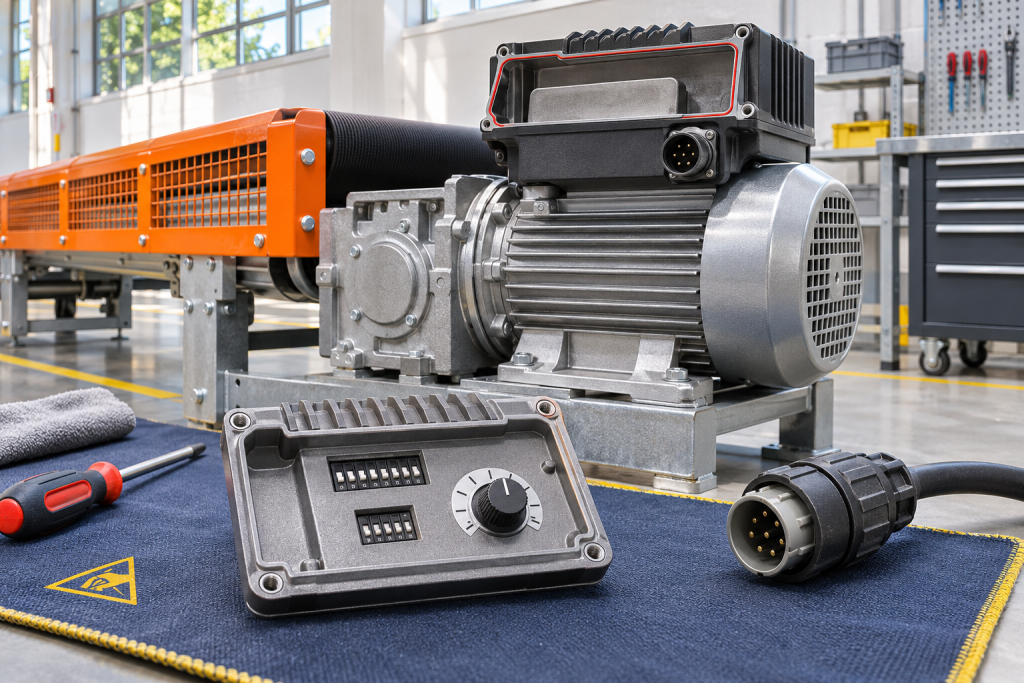
SEW-EURODRIVE’s MOVIMOT MM..D compact operating instructions distinguish local control elements, DIP switch groups, binary control and RS485 or fieldbus startup. They also include a unit-replacement section and refer users to the detailed operating instructions. This organization is a useful reminder that replacing the enclosure is not the same task as establishing the correct control configuration.
Do not turn that reminder into a universal switch-position recipe. The installation arrangement, control method and equipment variant determine which instructions apply. A maintenance note that merely says copy the old settings can conceal an unapproved historical change. The target should be the approved configuration for the machine, supported by current evidence, rather than whichever positions happen to be found first.
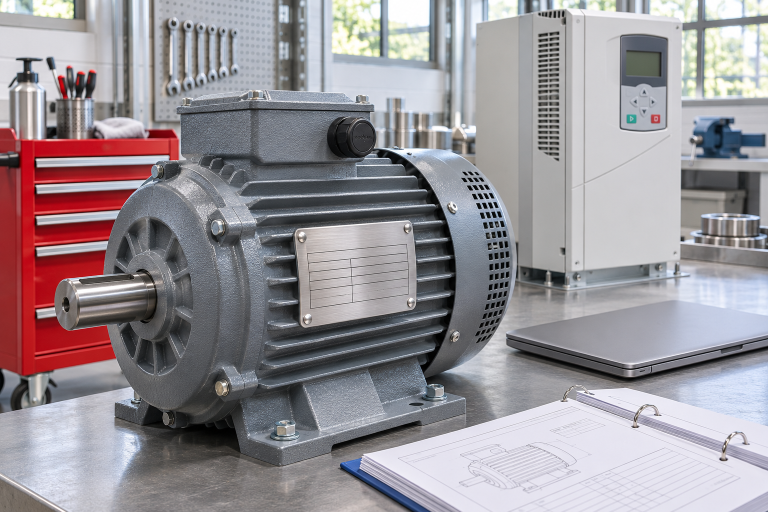
Separate the motor, inverter and machine identities
The SEW MM15D-503-00 inverter reference helps identify a candidate for a sourcing enquiry. Record it independently from the gearmotor designation, machine asset number and any interface assembly. A photograph showing only one label can leave the other identities unresolved, especially when stores descriptions have been shortened over several maintenance cycles.
The MM11D-503-00 MOVIMOT listing is another identifiable reference in the same broad family, not evidence of interchangeability with MM15D. Similar housings are not approval to substitute ratings or application requirements. Ask the responsible engineer to resolve the exact selection before an order is marked suitable for the machine.
A simple asset packet should show how these identities relate. Link the inverter reference to the motor record and then to the driven equipment. Include the location and drawing revision. This prevents a correct part number for one conveyor from becoming the default answer for a nearby conveyor whose mechanical load or control arrangement differs.
Make a physical-control record that can be reviewed
During an authorized, safely isolated inspection, qualified personnel can capture clear photographs and a structured record of relevant local controls. Record the orientation of the photograph and the reference markings used to interpret it. A close-up without orientation can be surprisingly difficult to review later, particularly when the receiving team is comparing a removed assembly with a differently positioned spare.
Alongside each recorded item, distinguish observed state from approved target state. Add the source of the target: an approved commissioning record, a machine builder document, or an engineering decision. If those sources disagree, retain the disagreement as an open issue. Do not resolve it by treating the most recent photograph as automatically authoritative.
Keep this information accessible without unpacking the spare. Attach the record to the asset in the maintenance system, and use a controlled reference on the stores label. That approach lets planners review readiness before the equipment is needed and reduces the temptation to inspect or adjust hardware hurriedly beside an interrupted production line.
Ask suppliers for evidence within their scope
A supplier can identify the offered unit, describe visible condition and state the scope of its test. Ask whether the photographs show the actual item and whether the reported settings were observed before or after testing. If a test fixture requires a temporary configuration, the final delivered state should be stated explicitly rather than inferred from an earlier image.
Do not ask a supplier to certify unknown machine behavior from a part number alone. Provide the application information needed for a meaningful compatibility discussion, and retain final engineering approval at the plant. Equally, avoid assuming that a generic tested label means the local controls have been prepared for your operating arrangement.
The purchase order can make these boundaries concise: exact inverter reference, included components, requested photographs, test description and delivery-state record. Clarify whether any application preparation is included. Where it is not, plan that work explicitly instead of allowing it to become an invisible task at installation.
Close the loop with controlled commissioning
Before commissioning, the authorized team should reconcile the spare, the physical-control record and the approved machine documentation. Apply the manufacturer’s complete procedures and site isolation requirements, including electrical and mechanical hazards. This article does not authorize live switch adjustment, bypassing protective functions, or trial-and-error rotation of a connected machine.
Acceptance should address observable machine requirements under an approved test plan. Record what was checked and who accepted it. If a mismatch appears, stop and investigate the configuration and hardware identity before changing multiple settings. A disciplined record makes a fault easier to explain and leaves the next maintenance team with a verified baseline rather than another undocumented exception.
Frequently asked questions
Does a parameter file describe every local control?
Do not assume that it does. Identify the actual control arrangement and preserve a separate record of relevant physical controls, with references to the applicable manufacturer documentation.
Should every replacement copy the removed unit?
Only an approved configuration should define the target. The removed unit is evidence of observed state, but its settings may include an undocumented change that still needs review.
Are MM11D and MM15D interchangeable because they look similar?
No such conclusion follows from appearance. Resolve the full inverter, motor and application requirements before approving any substitution between the two references.
What makes a useful supplier test report?
It identifies the actual unit, test conditions, checks performed, results and final delivered state. It clearly separates a bench assessment from validation on your machine.
Send DriveKNMS the complete inverter and motor references, application arrangement and available physical-control records when requesting a spare. A quotation built around those details gives maintenance a clearer starting point without replacing the plant’s commissioning responsibilities.
Image: AI-generated editorial illustration, not an exact product photograph or installation reference.
© 2026 DriveKNMS. All rights reserved. Official Website: https://driveknms.com Inquiry: sale@driveknms.com | WhatsApp/Tel: +86 18359293191