
Allen-Bradley 1756-OB16E Digital Output Module – ControlLogix 16-Point Spare Part
Allen-Bradley 1756-OB16E is listed for ControlLogix RFQ review. Confirm quantity, condition and destination before quotation.
RFQ-ready industrial model
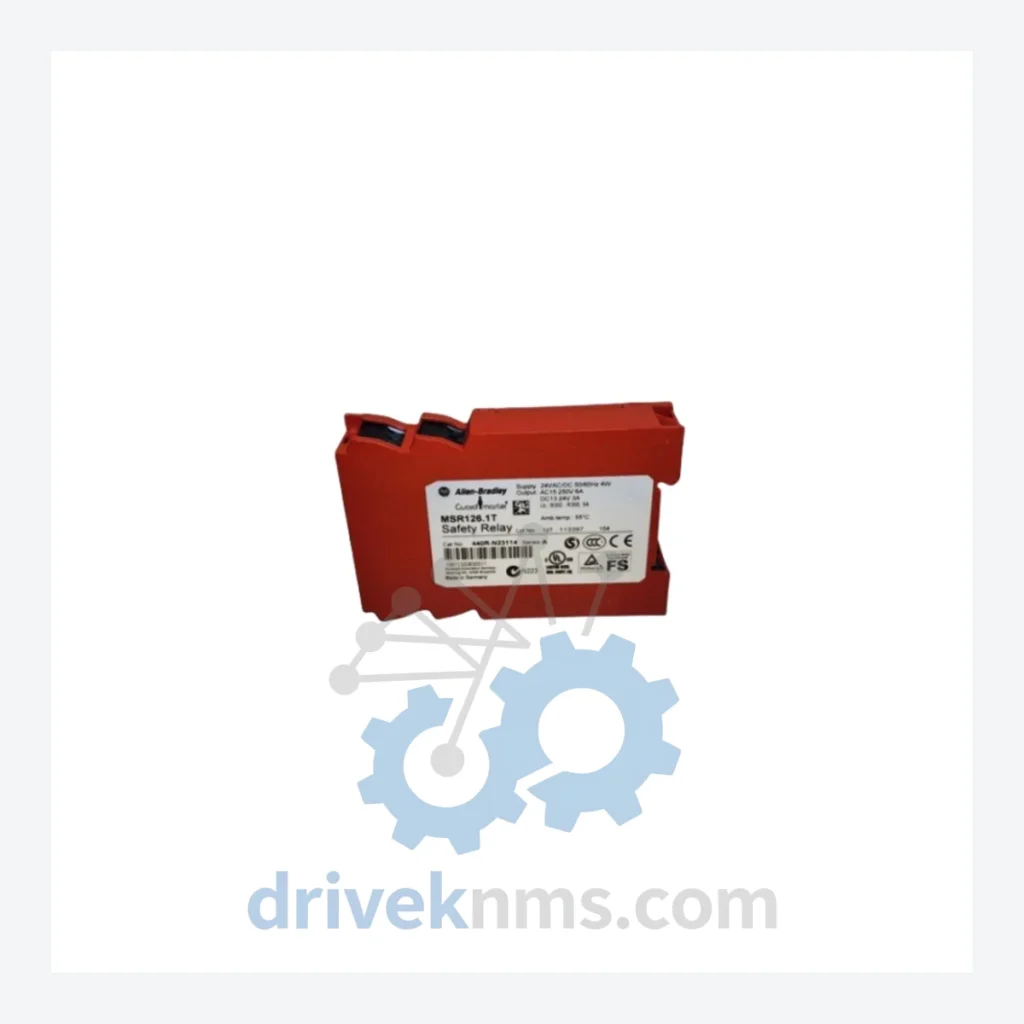
Model: 440C-CR30-22BBB
Product Overview
Commercial availability is handled through direct RFQ, model verification and export-oriented follow-up rather than public cart checkout.
Datasheet Preview
Use attached product manuals when available. If the manual is not public yet, request the full file directly through RFQ.
Commercial Path
Product pages on DRIVEKNMS are designed to verify model, brand and series first, then move the buyer into one clean quotation path.
Technical Dossier
DriveKNMS reviews sourcing options for discontinued components through RFQ handling before quotation.
RFQ support for obsolete parts: Send the model number, required quantity and destination so DriveKNMS can confirm sourcing options before quotation.
| Manufacturer | Allen-Bradley (Rockwell Automation) |
| Part Number | 440C-CR30-22BBB |
| Series | Guardmaster |
| Product Category | Safety Relay Module |
| Safety Output Contacts | 2 N.O. safety outputs |
| Auxiliary Output Contacts | 2 N.C. auxiliary outputs |
| Input Configuration | Dual-channel monitored input |
| Discontinuation Status | Confirmed discontinued by Allen-Bradley; no direct OEM replacement with identical form factor |
| Country of Origin | United States |
| Typical System Compatibility | Rockwell Automation Guardmaster safety relay panels; legacy machine safety circuits built to ISO 13849 / EN 954-1 Category 3 or 4 |
Q: How are RFQ terms confirmed?
A: Quantity, required condition, documentation needs, destination and sourcing route are confirmed during RFQ review before quotation.
For plant managers operating under capital expenditure constraints, the calculus is straightforward: a single verified spare unit at a fraction of the cost of a panel redesign preserves production capacity and defers a multi-hundred-thousand-dollar modernization project by five to ten years. That deferral window is not theoretical. Facilities that have maintained a strategic inventory of 440C-series spares have consistently avoided forced shutdowns when primary units failed.
Every 440C-CR30-22BBB unit processed by DriveKNMS passes a five-stage inspection protocol before it is offered for sale. This protocol was developed specifically for electromechanical safety components with known aging failure modes:
1. Electrolytic Capacitor Assessment: Internal capacitors are inspected for bulging, leakage, and ESR degradation. Units with capacitor aging beyond acceptable tolerance are rejected. This is the most common failure mode in stored safety relays from this era.
2. Firmware and Version Verification: Where applicable, firmware revision is confirmed and documented. Mixed firmware revisions within a safety panel are a known source of nuisance tripping and diagnostic faults.
4. Functional Relay Cycling Test: Safety output contacts are cycled under load to verify actuation force, contact closure resistance, and release timing against original specification ranges.
5. Visual and Cosmetic Audit: Housing integrity, label legibility, and connector condition are documented. Units showing evidence of prior field repair, burn marks, or housing damage are excluded from inventory.
The 440C-CR30-22BBB is a hardwired, form-factor-identical replacement for failed units within existing Guardmaster safety relay panels. No PLC reprogramming is required. No safety logic modifications are necessary. The replacement unit mounts to the same DIN rail position, connects to the same terminal block wiring, and restores the panel to its original certified state — provided the rest of the safety circuit remains unchanged.
This drop-in characteristic is the core economic argument for sourcing a spare rather than redesigning the panel. Engineering labor for a panel redesign on a Category 3 or 4 safety circuit typically runs 80 to 200 hours, excluding validation testing and documentation. At current industrial engineering rates, that labor cost alone exceeds the cost of maintaining a two-unit spare inventory for the life of the machine.
For facilities operating multiple lines with identical safety panel configurations, a centralized spare parts strategy — holding two to four units per panel design — provides meaningful protection against both random failure and the increasing difficulty of sourcing these components on short notice.
Conduct a single-point-of-failure audit. Identify every component in your safety and control architecture that is discontinued or approaching end-of-life. Safety relays, legacy I/O modules, and first-generation servo drives are the most common failure points. The 440C-CR30-22BBB is a textbook example: widely deployed, discontinued, and with no direct OEM replacement.
Document your panel configurations before failures occur. Wiring diagrams, safety validation reports, and firmware revision records are frequently lost over the operational life of a machine. Reconstructing this documentation after a failure, under production pressure, is expensive and error-prone. Maintaining current documentation reduces repair time and supports future sourcing decisions.
Set a five-year review cycle. Every five years, reassess which components in your legacy inventory have become critically scarce. Components that were available in quantity five years ago may be nearly impossible to source today. Proactive purchasing at the five-year mark consistently yields better pricing and availability than emergency purchasing at the point of failure.
Q: Can you support multi-unit or repeat RFQ requests?
A: Yes. Send the model list, target quantity and destination so DRIVEKNMS can review sourcing options and quote the requirement as a project RFQ.
Continue The Model Path
Move from this exact model into the matching system hub, brand archive, model-family archive or lifecycle sourcing route before sending a final RFQ list.
Related Paths
Allen-Bradley 1756-OB16E is listed for ControlLogix RFQ review. Confirm quantity, condition and destination before quotation.
Allen-Bradley 1336-L6/B is listed for Controller Cards RFQ review. Confirm quantity, condition and destination before quotation.
Allen-Bradley 1786-BNC is listed for Controller Cards RFQ review. Confirm quantity, condition and destination before quotation.