
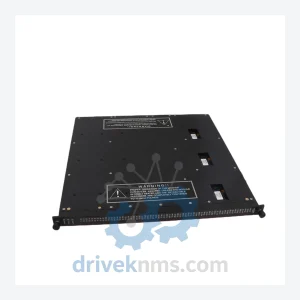
TRICONEX 3500 Series Modules – 3511 Pulse Input Module
Triconex 3511 is listed for 3500 RFQ review. Confirm quantity, condition and destination before quotation.
RFQ-ready industrial model
Model: 3500/04 136719-01 128275-01F
Product Overview
Commercial availability is handled through direct RFQ, model verification and export-oriented follow-up rather than public cart checkout.
Datasheet Preview
Use attached product manuals when available. If the manual is not public yet, request the full file directly through RFQ.
Commercial Path
Product pages on DRIVEKNMS are designed to verify model, brand and series first, then move the buyer into one clean quotation path.
Technical Dossier
The 3500 platform was introduced in the mid-1990s as the successor to the Bently Nevada 3300 and 7200 series, consolidating discrete single-channel monitors into a unified rack system with a shared communication backplane. The original architecture used a proprietary Transient Data Interface (TDI) for waveform capture and communicated via RS-232/RS-422 serial links to host DCS systems.
The first major revision introduced the 3500/92 Communication Gateway with Modbus RTU and TCP/IP support, enabling integration with Honeywell DeltaV, Emerson Ovation, ABB 800xA, and Yokogawa CENTUM VP. A subsequent hardware revision added the 3500/93 Communication Gateway with OPC DA/UA server capability, eliminating the need for third-party OPC bridges in most installations.
The current generation introduced System 1 Evolution software compatibility, replacing the legacy System 1 v5.x platform. Modules manufactured after approximately 2010 carry the -01 or -02 firmware suffix and are not backward-compatible with pre-2005 rack firmware without a rack controller upgrade. Facilities operating original 3500 racks from the late 1990s must verify the 3500/05 Rack Interface Module (RIM) firmware version before mixing module generations. The 3500 Series is now in a mature/sustained phase; Baker Hughes continues to manufacture select modules but has issued end-of-active-development notices for several I/O variants. Long-term maintenance support and spare inventory management are therefore critical operational requirements for any facility running this platform.
Rack Infrastructure & Power
Vibration Monitoring — Proximity Probes (Eddy Current)
Vibration Monitoring — Seismic / Velocity
Process & Temperature Monitoring
Communication & Integration
Several 3500 Series modules — including early revisions of the 3500/40, 3500/42 (non-M suffix), 3500/05 (pre-2005 firmware), and 3500/20 — have been discontinued by Baker Hughes with no direct OEM replacement. Facilities that cannot migrate to the System 1 Evolution platform or the newer 3701 Series require a reliable source of tested surplus and refurbished modules to sustain existing rack installations through their remaining operational life, which in many cases extends 15 to 25 years beyond the module production end date.
The 3500 Series backplane uses a proprietary differential serial bus for inter-module communication. Functional verification of any 3500 module therefore requires a complete rack environment — isolated bench testing of individual modules without a live rack and RIM is insufficient to confirm communication integrity or relay output behavior.
DriveKNMS performs 3500 Series module verification using a dedicated test rack equipped with a calibrated 3500/05 RIM, reference 3500/15 Power Supply, and calibrated signal sources traceable to NIST standards. Each module undergoes: (1) power-on self-test (POST) pass verification; (2) channel-by-channel input simulation using calibrated proximity probe simulators or thermocouple/RTD decade boxes; (3) alarm and relay output actuation at configured setpoints; (4) communication bus integrity check via System 1 software polling; and (5) visual inspection of backplane connector pins and conformal coating condition. Modules that fail any stage are quarantined and not offered for sale.
Continue The Model Path
Move from this exact model into the matching system hub, brand archive, model-family archive or lifecycle sourcing route before sending a final RFQ list.
Related Paths
Triconex 3511 is listed for 3500 RFQ review. Confirm quantity, condition and destination before quotation.
Triconex 3501E is listed for 3500 RFQ review. Confirm quantity, condition and destination before quotation.
Triconex 3533E is listed for 3500 RFQ review. Confirm quantity, condition and destination before quotation.