Technical Dossier
Product Details And Specifications
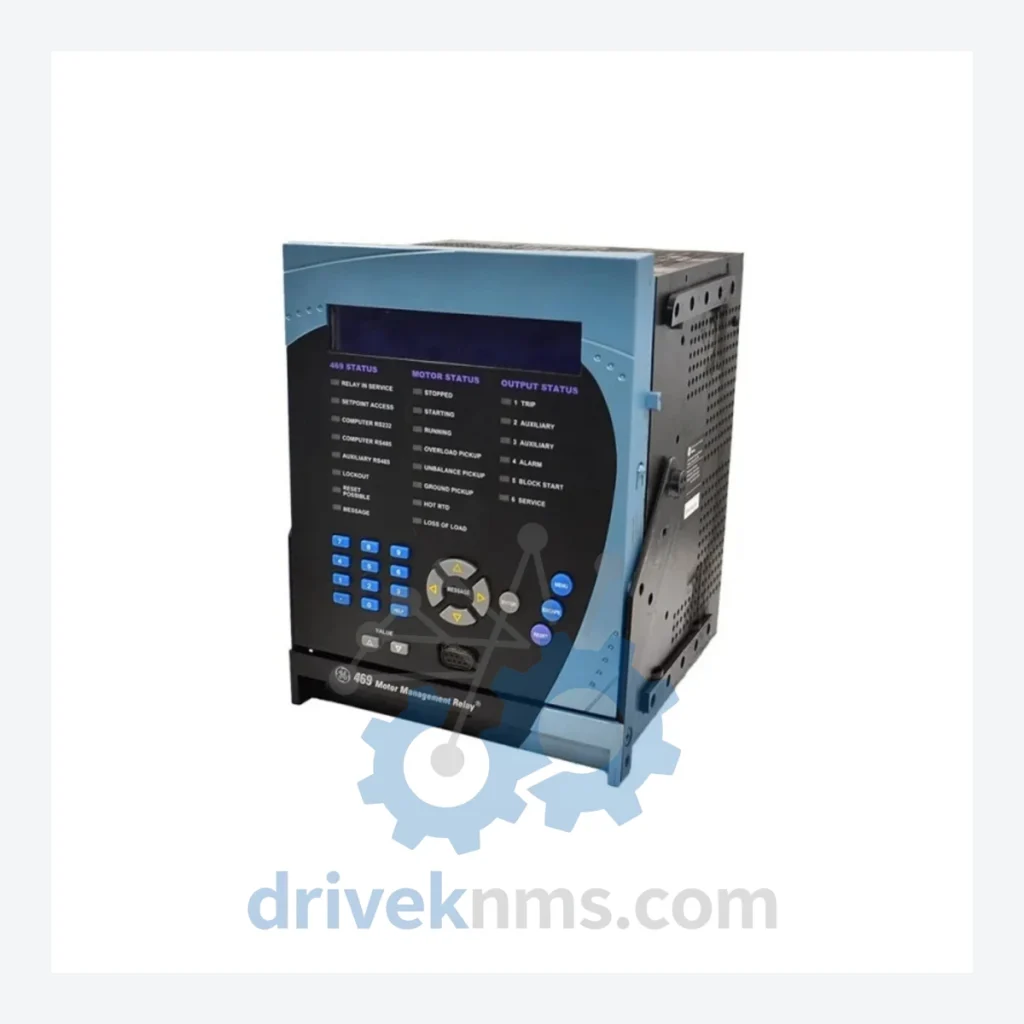
GE 469-P5-HI-A20-E Motor Management Relay – Obsolete Multilin Series Spare Part
When a GE Multilin 469 motor management relay fails, the consequences extend far beyond a single motor going offline. The 469 series is deeply embedded in legacy motor control centers (MCCs), switchgear lineups, and distributed control architectures across petrochemical plants, pulp and paper mills, water treatment facilities, and heavy manufacturing operations. A forced migration away from the 469 platform — driven by a single failed unit — can trigger a cascade of engineering costs: new relay panels, updated protection coordination studies, revised PLC/DCS interface wiring, and mandatory recommissioning. Conservative estimates place full-system upgrade costs in the range of several hundred thousand to several million USD per affected motor bus. DriveKNMS maintains RFQ-reviewed sourcing status of the 469-P5-HI-A20-E to give plant engineers and maintenance managers a direct, low-cost alternative to that scenario.
RFQ support for obsolete parts: Send the model number, required quantity and destination so DriveKNMS can confirm sourcing options before quotation.
Technical Specifications
| Parameter | Detail |
| Manufacturer | GE Multilin (General Electric) |
| Part Number | 469-P5-HI-A20-E |
| Series | Multilin 469 Motor Management Relay |
| Discontinuation Status | Discontinued / Obsolete – superseded by GE Multilin 869 platform |
| Power Supply | P5 = 85–265 VAC / 88–300 VDC universal power supply |
| CT Input Range | HI = High-level CT inputs (1A and 5A secondary) |
| Analog Outputs | A20 = 2 analog outputs (4–20 mA) |
| Communications | E = Ethernet (10Base-T) communications port |
| Country of Origin | Canada |
| Compatible Systems | GE MCC lineups, legacy SCADA/DCS via Modbus TCP, DNP3 |
Solving the Discontinued Hardware Crisis
Q: How are RFQ terms confirmed?
A: Quantity, required condition, documentation needs, destination and sourcing route are confirmed during RFQ review before quotation.
The 469-P5-HI-A20-E specifically addresses high-current motor applications requiring dual analog output channels and Ethernet connectivity for integration with modern SCADA infrastructure — a configuration that cannot be substituted with a lower-specification 469 variant without hardware and firmware changes.
Extending Asset Life 5–10 Years: A Maintenance Strategy for Plant Management
The decision to extend a legacy motor protection platform rather than replace it is a capital allocation decision, not a technical compromise — provided the maintenance strategy is disciplined. The following framework has been applied successfully in facilities operating GE Multilin 469 systems beyond their nominal support lifecycle:
1. Criticality-Based Spare Holding. Classify each 469 variant in your installation by motor criticality (production-critical, safety-critical, non-critical). Hold a minimum of one cold spare per variant for production-critical and safety-critical motors. The 469-P5-HI-A20-E, with its Ethernet port and dual analog outputs, typically appears on critical motor buses where remote monitoring is mandatory — these units warrant priority stocking.
2. Firmware Version Control. Document the firmware revision installed on each active 469 unit. Replacement units must match the firmware version to ensure identical protection characteristic behavior. DriveKNMS verifies firmware versions on all units prior to shipment.
3. Scheduled Preventive Inspection. Electrolytic capacitors in the 469 power supply board have a finite service life. At 15+ years of operation, capacitor degradation is the leading cause of relay failure. Scheduled inspection and capacitor replacement on a 5-year cycle can extend relay service life by an equivalent period at a fraction of replacement cost.
4. CT and Wiring Integrity Audits. Corroded CT secondary terminals and degraded insulation on RTD wiring are common failure precursors in aging 469 installations. Annual thermographic inspection of relay panels and CT junction boxes is a low-cost intervention that prevents nuisance trips and relay damage.
5. Centralized Spare Parts Registry. Maintain a plant-wide registry of all 469 variants, serial numbers, firmware versions, and associated motor data. This registry becomes the procurement specification when sourcing replacement units and eliminates the risk of receiving an incompatible variant under time pressure.
Condition & Reliability Assurance
Sourcing obsolete relay hardware from the secondary market carries inherent risk. DriveKNMS applies a structured 5-step quality assurance process to every 469-P5-HI-A20-E unit before it leaves our facility:
Step 1 – Visual and Mechanical Inspection. Full external inspection for physical damage, connector pin corrosion, and housing integrity. Units with corroded or bent pins on the rear terminal block are rejected at this stage.
Step 2 – Electrolytic Capacitor Assessment. Power supply and I/O board capacitors are tested for capacitance value and ESR (equivalent series resistance). Capacitors showing degradation beyond manufacturer tolerance are replaced with equivalent-specification components before the unit proceeds.
Step 4 – Functional Power-On Test. The unit is powered and subjected to a full self-diagnostic cycle. Communication port functionality (Ethernet) and analog output channel integrity are verified under load.
Key Features for System Maintenance
The 469-P5-HI-A20-E is a direct drop-in replacement for any existing 469-P5-HI-A20-E installation. No relay reprogramming is required provided the replacement unit carries the same firmware revision as the unit being replaced. Existing CT wiring, RTD wiring, analog output wiring, and Ethernet connections are reused without modification. This eliminates the engineering labor cost associated with relay substitution across different product families and avoids the mandatory protection coordination review that a platform change would trigger. For maintenance teams operating under tight turnaround windows, the ability to swap a failed unit and restore motor protection within hours — rather than days or weeks — is the defining operational advantage of maintaining like-for-like spare inventory.
Q: How is condition confirmed before quotation?
A: Available condition, photos, test records and documentation are checked according to the requested model and sourcing channel before a formal RFQ response.