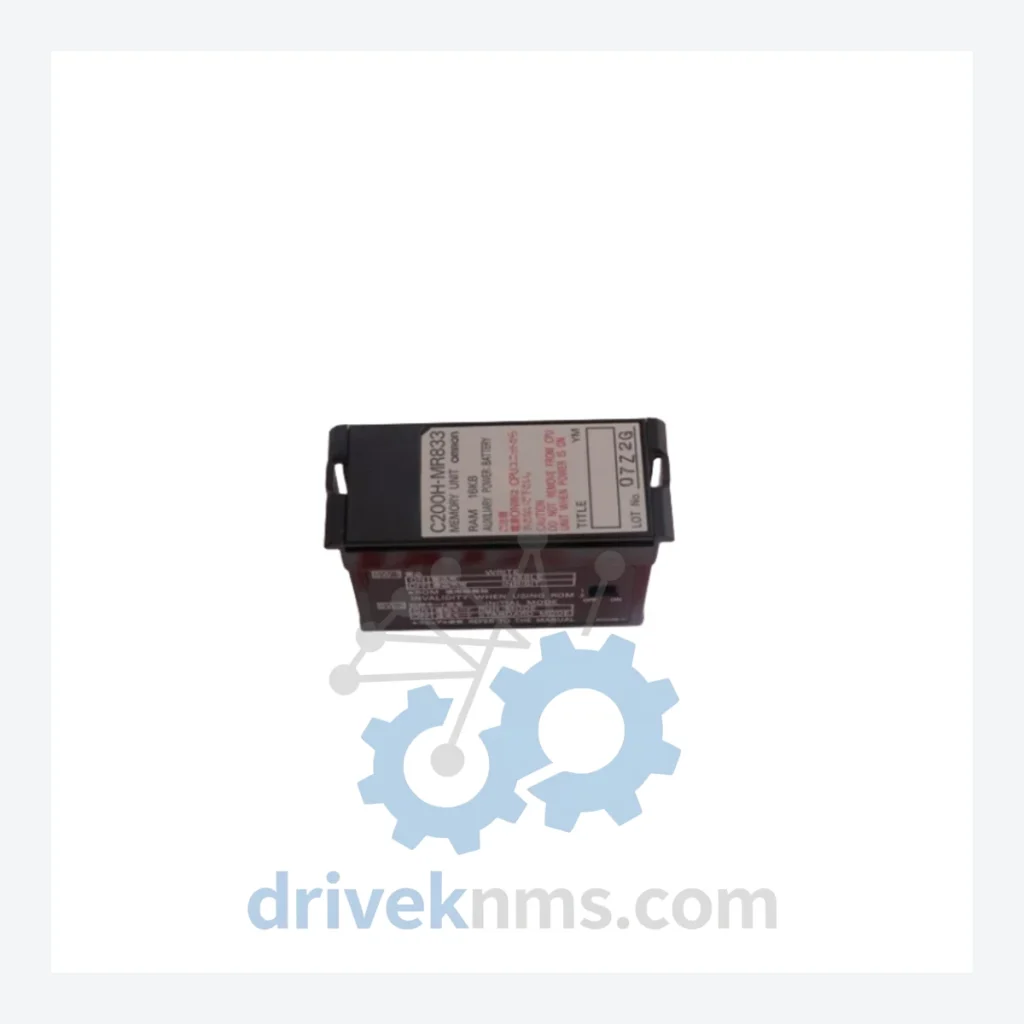
OMRON CPM2C-8EDM CPU Unit – Obsolete CPM2C Series Spare Part
OMRON CPM2C-8EDM CPU Unit – Obsolete CPM2C Series Spare Part When an OMRON CPM2C-8EDM CPU unit fails on the production…
Model: CP1W-8ER
Product Overview
Commercial availability is handled through direct RFQ, model verification and export-oriented follow-up rather than public cart checkout.
Datasheet Preview
Use attached product manuals when available. If the manual is not public yet, request the full file directly through RFQ.
Commercial Path
Product pages on DRIVEKNMS are designed to verify model, brand and series first, then move the buyer into one clean quotation path.
Technical Dossier
When an Omron CP1W-8ER fails on an active production line, the consequences are not limited to a module replacement cost. For facilities still running CP1-series PLC architectures, a single unresolved I/O failure can force a full control system migration — a project that routinely exceeds $500,000 USD when engineering hours, downtime, revalidation, and operator retraining are factored in. DriveKNMS maintains verified stock of the CP1W-8ER specifically to prevent that outcome. This is not a commodity listing. It is a documented asset-protection measure for operations that cannot afford a forced upgrade on a compressed timeline.
| Parameter | Value |
|---|---|
| Part Number | CP1W-8ER |
| Manufacturer | Omron Corporation |
| Series | CP1W (CP1 Expansion I/O) |
| Module Type | Relay Output Expansion Module |
| Output Points | 8 relay outputs |
| Terminal Type | Screw Terminal |
| Compatible PLC Families | Omron CP1L, CP1H, CP1E series |
| Discontinuation Status | Discontinued / Obsolete – No longer in Omron active production |
| Country of Origin | Japan |
Note: Electrical parameters not listed here are not confirmed from verified datasheets. DriveKNMS does not publish unverified specifications. Contact us for full datasheet documentation.
The CP1W expansion I/O family was designed as a tightly integrated ecosystem. The CP1W-8ER relay output module connects directly to CP1L, CP1H, and CP1E CPU units via the side expansion bus — a proprietary interface that accepts no third-party substitutes without hardware and software rework. Facilities that built their machine control logic around this architecture in the 2000s and early 2010s now face a specific problem: Omron has discontinued the CP1W line, and the replacement pathway (CP2E or NX1P2 platforms) requires PLC program migration, I/O remapping, and in many cases, panel rewiring.
For a single production cell, that migration can consume 3–6 weeks of engineering time. For a multi-line facility with 20–40 CP1-series controllers, the scope becomes a capital project. The CP1W-8ER is not a high-value component in isolation — but its absence can trigger a disproportionately expensive chain of events. Maintaining a documented spare inventory of CP1W expansion modules is the lowest-cost strategy available to defer that migration on your schedule, not on the schedule imposed by a hardware failure.
Facilities running Omron CP1-series PLCs in conjunction with older HMI systems (such as Omron NS-series terminals) or legacy SCADA integrations face additional complexity: the control architecture is interdependent, and replacing one layer often forces changes across the entire stack. A $200 relay output module, sourced and held in reserve, can protect years of validated control logic from premature obsolescence.
DriveKNMS applies a structured 5-step quality process to all obsolete and legacy components before shipment:
Units that do not pass all five stages are not listed for sale.
The decision to replace a functioning control system is rarely driven by performance. It is driven by parts availability. When a critical component becomes unobtainable, the system becomes a liability — not because it stopped working, but because the next failure cannot be recovered from. This is the core risk that obsolete spare inventory management addresses.
For facilities operating Omron CP1-series PLCs, a structured approach to spare parts procurement can realistically extend the operational life of the installed base by 5 to 10 years beyond the point at which Omron ceased production. The strategy involves three elements: identifying the highest-failure-risk modules in the architecture (relay output modules, power supply units, and CPU boards), establishing a documented minimum stock level for each, and sourcing from verified suppliers before market availability deteriorates further.
Relay output modules such as the CP1W-8ER carry elevated failure risk relative to solid-state I/O modules because mechanical relay contacts have a finite cycle life. In high-cycle applications, these modules may require replacement every 3–5 years under normal operating conditions. In a discontinued product line, that replacement cycle becomes a procurement problem, not just a maintenance task. Facilities that have not yet established a spare inventory for CP1W relay output modules are operating with an unquantified risk exposure that grows as remaining market stock is absorbed.
The cost of holding two to four CP1W-8ER units in a documented spare parts cabinet is negligible relative to the cost of a single unplanned line stoppage. For plant managers and maintenance engineers responsible for aging automation assets, this is not a purchasing decision — it is a risk management decision.
Q: What warranty applies to obsolete parts?
A: DriveKNMS provides a 90-day warranty covering functional defects identified under normal operating conditions. Units that fail within the warranty period are replaced or refunded. Warranty does not cover damage resulting from incorrect installation or electrical overstress.
Q: How do I know the unit is genuine and not counterfeit?
A: All units are sourced through documented supply channels. Hardware revision markings, label printing, and physical construction are verified against known authentic production references. We do not list units where authenticity cannot be confirmed.
Q: Are units new or refurbished?
A: Stock condition varies. Each listing specifies whether units are new-in-box (NIB), new-old-stock (NOS), or professionally refurbished. Refurbished units complete the full 5-step QA process described above before shipment.
Q: Should I buy more than one unit?
A: For any CP1W relay output module in active use, holding a minimum of two spare units is a defensible maintenance position. As market availability of discontinued CP1W components continues to decline, procurement lead times and unit costs will increase. Purchasing ahead of an immediate need is the lower-cost option.
Q: Can you source other CP1W expansion modules?
A: Yes. Contact us with your full bill of materials for CP1W expansion I/O requirements. We maintain sourcing networks for the broader CP1W family including digital input, analog I/O, and communication modules.
© 2026 DriveKNMS. All trademarks belong to their respective owners. Specifications are for reference only and subject to change without notice. Verify all parameters against official documentation before installation.