An axis that faults only during acceleration is often described as a bad servo motor. That shorthand is convenient, but it combines several very different causes: encoder feedback interruption, damaged cable shielding, connector contamination, incorrect motor data, drive feedback input failure, mechanical binding or a genuine motor defect. Replacing the motor without separating these possibilities can consume a shutdown window and reproduce the same fault on the replacement. Start by preserving the drive alarm, motion command, axis position, speed, load and event timing. A feedback fault that appears only when a cable flexes or a machine reaches a certain travel position deserves a different investigation from a fault that persists at standstill.
Build the axis identity before testing
Record the controller axis, drive model and firmware, motor model, encoder type, feedback cable part number and length, connector keying, gear ratio, brake arrangement and application limits. Compare the drive parameter set with the approved backup, and save the as-found values before changing anything. Note whether the alarm appears at power-up, enable, homing, acceleration, deceleration or a repeatable mechanical position. Trend commanded and actual position, velocity, following error, torque and feedback-quality indicators on the same time scale. The Yaskawa SGMG-30ASA in the DriveKNMS live catalog can be a relevant motor reference, but the series label alone does not confirm encoder interface, brake, shaft or drive compatibility.
Inspect the feedback path as a complete circuit
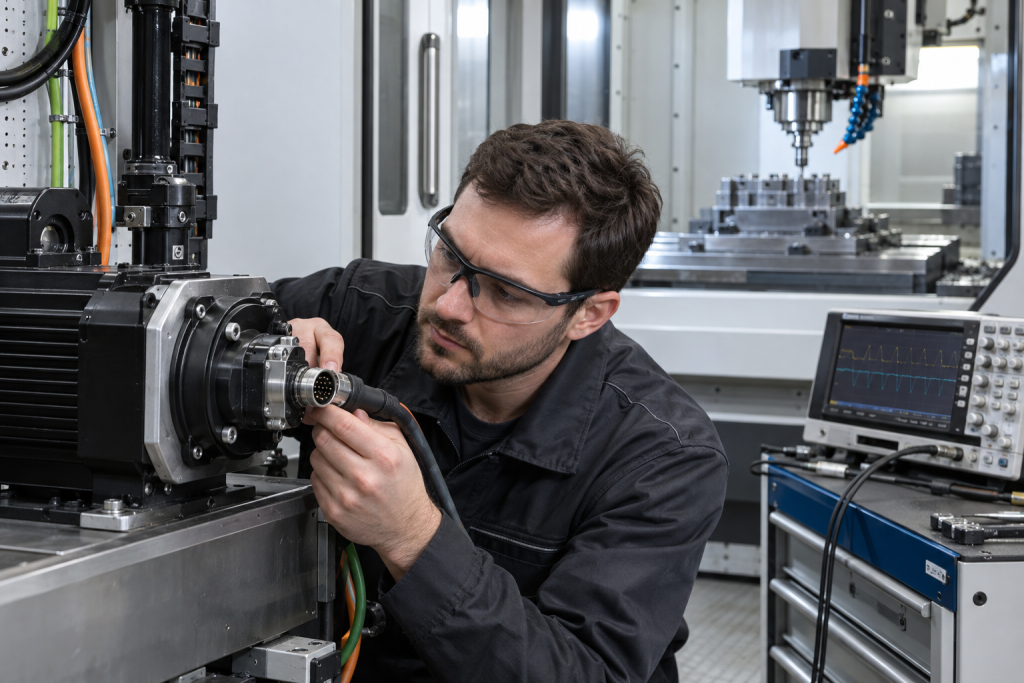
With the machine in its approved safe state, inspect connectors for bent pins, moisture, oil, damaged seals, strain and poor locking. Check cable routing near motor leads, contactors and high-current conductors; poor separation or a compromised shield can create intermittent noise that looks like an encoder failure. Verify shield termination follows the OEM and site design at the specified end or ends. Do not improvise grounding changes while powered. Look for tight bend radii, abrasion at drag-chain transitions and connectors that rotate under vibration. If the alarm correlates with carriage movement, inspect the full cable travel and flex section rather than only the cabinet end.
The live site catalog includes Yaskawa SGMG-30ASA servo motor as identification references for this equipment family. Verify the full installed configuration, ratings and revision before treating any catalog match as an approved replacement.
Test electronics without introducing a second fault
Use the vendor procedure and approved test equipment to check feedback supply, differential signals or communication quality as appropriate to the encoder technology. Do not apply a generic resistance or voltage threshold across different encoder types. Where permitted, compare the drive’s feedback monitor with a known-good axis of the same configuration, while recognizing that a swap can transfer parameters or create a new mismatch. Isolate one boundary at a time: cable and connector, motor feedback device, drive input, then controller scaling. Record the test conditions, values, instrument and configuration. Never megger an encoder circuit or apply insulation-test voltage through connected electronics unless the manufacturer procedure explicitly permits it.
Check motor and mechanical evidence separately
A true motor issue may present as winding imbalance, insulation deterioration, bearing damage, brake drag, thermal overload or an encoder fault, but those observations need distinct tests. Follow lockout and electrical safety rules before disconnecting. Verify that the motor brake releases as expected, the load moves freely under the approved method and coupling alignment has not shifted. Compare motor temperature, phase current and torque demand against a healthy baseline. An axis that draws abnormal torque with stable feedback may be mechanically overloaded; an axis with normal torque but discontinuous counts may point toward feedback. Do not infer a winding defect from a drive alarm label alone.
Make the replacement decision auditable
If evidence supports a motor or feedback-component replacement, specify the complete motor nameplate, encoder code, brake and shaft options, connector orientation, cable length, drive family, firmware, required condition and application environment. Ask the supplier to state the exact part identity and test evidence, not merely “compatible.” Define incoming acceptance such as visual inspection, insulation test boundaries, encoder communication check and parameter restoration plan. The Yaskawa catalog listing is an item identity to investigate, not an assurance that every SGMG configuration is a drop-in replacement. Keep the removed component tagged with its fault history for repair analysis or warranty review.
Use a controlled comparison after repair
After the cable, encoder, drive or motor repair, repeat the same low-risk motion profile that first produced the fault. Compare following error, feedback quality, current, torque and axis temperature with the as-found record. Check slow jog, homing, acceleration and full travel only as authorized by the machine owner, with guards and safety functions intact. Listen and observe for brake release, coupling noise and cable-chain interference. If the axis passes a brief test but operates intermittently, extend monitoring across enough cycles and travel positions to include the original trigger. Record any parameter change separately from a hardware replacement so the team can identify which intervention resolved the symptom.
Questions Maintenance Teams Ask
faq
Does an encoder alarm mean the motor must be replaced?
Can I swap motor and feedback cables to see whether the fault moves?
Only under an approved isolation and change procedure, with exact connector and configuration checks. Uncontrolled swapping can damage electronics or create a hazardous axis motion.
Why do feedback faults happen only at certain positions?
A flexing cable, connector strain, local interference, mechanical vibration or a position-dependent load can expose an intermittent condition. Correlate the fault with travel and cable movement.
What information makes a servo motor quote useful?
Provide the full motor and encoder identifiers, brake and shaft options, drive model, cable details, fault evidence, requested condition and acceptance criteria.
For a motion-control RFQ, send DriveKNMS the motor and encoder labels, drive model, connector and cable photos, alarm history, application details, condition requirement and downtime window. We can help verify the exact identity before a replacement decision.
© 2026 DriveKNMS. All rights reserved. Official Website: https://driveknms.com Inquiry: sale@driveknms.com | WhatsApp/Tel: +86 18359293191