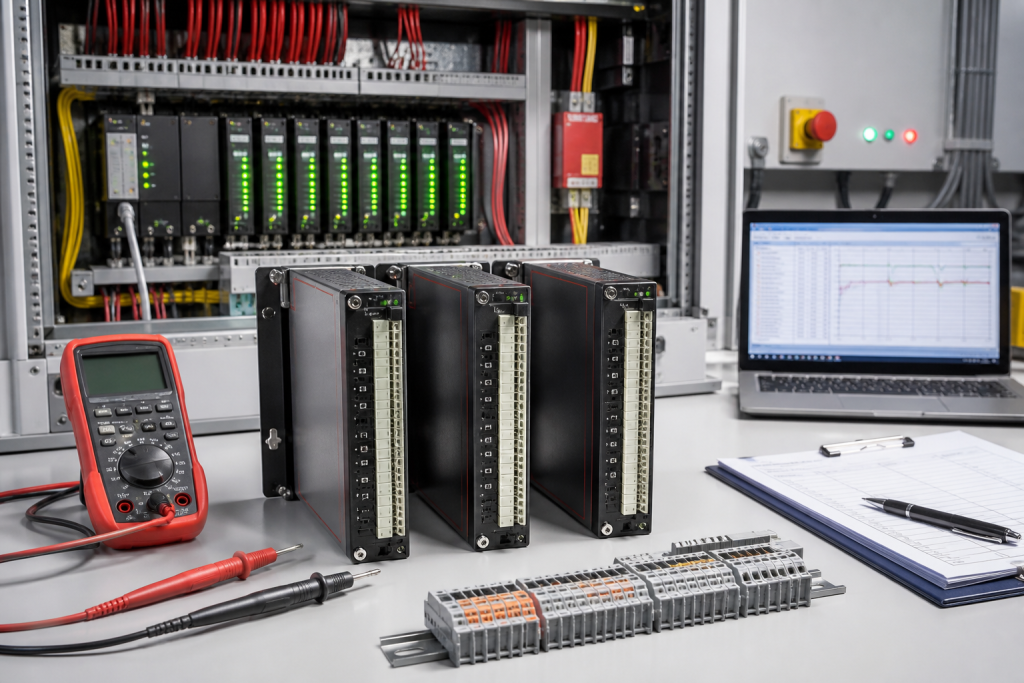
A TMR output channel deserves more care than a normal I/O replacement. When a Triconex analog output module is tied to a shutdown valve, speed reference, actuator demand, or package-unit safety action, the spare must be chosen with the safety function and proof-test method visible from the beginning.
DriveKNMS readers are often asked to support safety systems that cannot wait for a full migration. The purchasing problem is not simply finding a module with the same family name. It is proving that the spare, terminals, channel behavior, and test evidence can support a controlled return to service.
Start With The Safety Action
Record module model, slot, channel list, output range, field load, terminal wiring, safety function, bypass state, diagnostic history, trip logic, and the proof-test step that will release the channel.
The live Triconex 3805E analog output module is the direct product match when the RFQ involves 4-20 mA output behavior in a TMR safety cabinet.
Photograph labels, terminals, field wiring, cabinet position, LEDs, bypass records, logic reference, and the final element affected by the output.
Adjacent TMR Modules Need Separate Evidence
Input, pulse input, communication, and analog output modules may share a chassis, but they do not share the same acceptance method. A channel-by-channel review keeps procurement aligned with functional safety.
The related Triconex 3511 pulse input module is useful as a comparison point for TMR module sourcing, but it should not blur the output-channel requirement.
Ask for exact replacement, tested exchange, refurbished, and substitute options separately. Each quote should state condition, channel-test evidence, terminal scope, warranty, and unresolved compatibility questions.
Proof Testing Must Close The Loop
After replacement, verify module recognition, channel diagnostics, output range, final-element response, trip interaction, bypass removal, alarm behavior, event records, and the approved proof-test result.
If the test fails, check wiring polarity, loop power, field device health, configuration, bypass status, and final element movement before blaming the spare.
Keep the RFQ evidence, photos, channel list, proof-test sheet, and safety approval with the spare record.
Procurement Evidence That Should Travel With The Spare
Send module labels, channel list, terminal photos, final-element details, required condition, test scope, and shutdown deadline.
A safety buyer should ask whether output channels were tested or whether the item was only visually inspected. That distinction matters when the maintenance window is already open.
For substitutes, require a documented safety-engineering decision that covers channel behavior, diagnostics, project compatibility, and validation scope.
The practical discipline is to keep identity, function, and acceptance separate. Identity proves what the item is. Function proves what the plant expects it to restore. Acceptance proves the maintenance team has a credible way to put the asset back into service.
This matters most on older PLC, DCS, SIS, HMI, drive, and protection systems because the same family name can hide different firmware, terminals, power paths, suffixes, accessories, or configuration assumptions. A correct purchase starts with the installed evidence, not with a copied description.
Ask for actual-item photographs when the outage window is short. Front labels, side labels, connector faces, terminal assemblies, memory devices, latches, and LED panels often reveal details that a catalog title misses.
Condition language should be explicit. New surplus, factory sealed, refurbished, repaired exchange, tested used, and untested used items carry different risks. Procurement should compare condition and test scope before comparing price or lead time.
Accessory scope is another common failure point. Terminal blocks, cables, mounting brackets, memory cards, connector kits, batteries, license media, and parameter backups may not be included with the base hardware. Name those items before the purchase order is approved.
A useful RFQ also names the fallback. If the item fails bench checks or field acceptance, the plant should know whether it will reinstall the old part, use a repaired exchange, isolate a noncritical function, or escalate the case to a migration review.
The best spare records are boring in the right way. They contain enough photos, model evidence, wiring notes, configuration references, and acceptance criteria that a night-shift engineer can understand the decision without calling everyone who attended the original meeting.
For global plants, this also reduces avoidable back-and-forth with procurement. A supplier can respond faster when the request separates the mandatory match points from the nice-to-have preferences and states which uncertainty requires engineering approval.
Do not let a successful bench power-up become the whole acceptance plan. Bench checks are useful, but the real question is whether the item restores the installed function in the rack, cabinet, loop, axis, network, or safety channel where it will be used.
When lifecycle pressure is building, a spare purchase can also become a migration signal. If exact replacements are scarce, test evidence is weak, or substitutes require heavy engineering review, record that fact so the next budget discussion is based on maintenance reality rather than surprise downtime. Evidence compounds.
FAQ
What must match on a Triconex 3805E spare?
Match module model, channel role, output range, terminal scope, TMR cabinet role, diagnostics, and proof-test method.
Can another Triconex module be used instead?
Only after channel type, firmware or revision, terminals, project compatibility, and safety approval are reviewed.
What should the RFQ include?
Send labels, channel list, terminal and final-element photos, condition requirement, proof-test scope, and deadline.
What proves recovery?
Healthy diagnostics, correct output behavior, restored final-element response, bypass closure, event record, and approved proof-test results.
Send DriveKNMS the Triconex labels, channel list, terminal photos, final-element details, condition requirement, and proof-test deadline. We can help prepare a controlled TMR output RFQ.
© 2026 DriveKNMS. All rights reserved. Official Website: https://driveknms.com Inquiry: sale@driveknms.com | WhatsApp/Tel: +86 18359293191