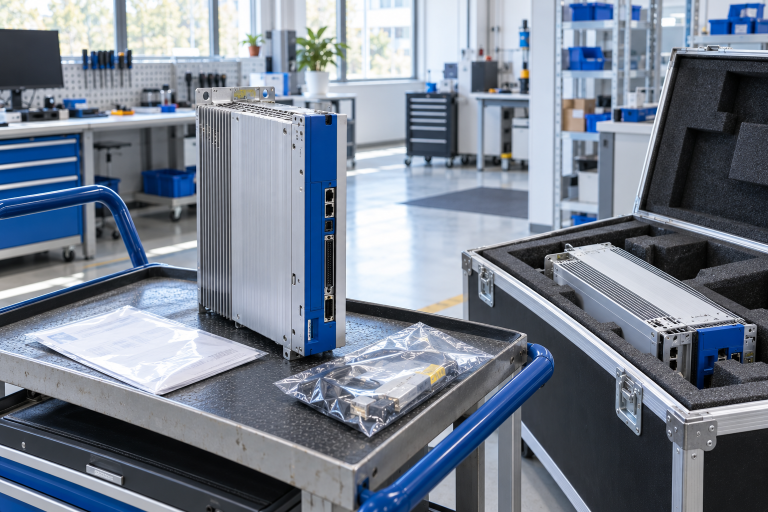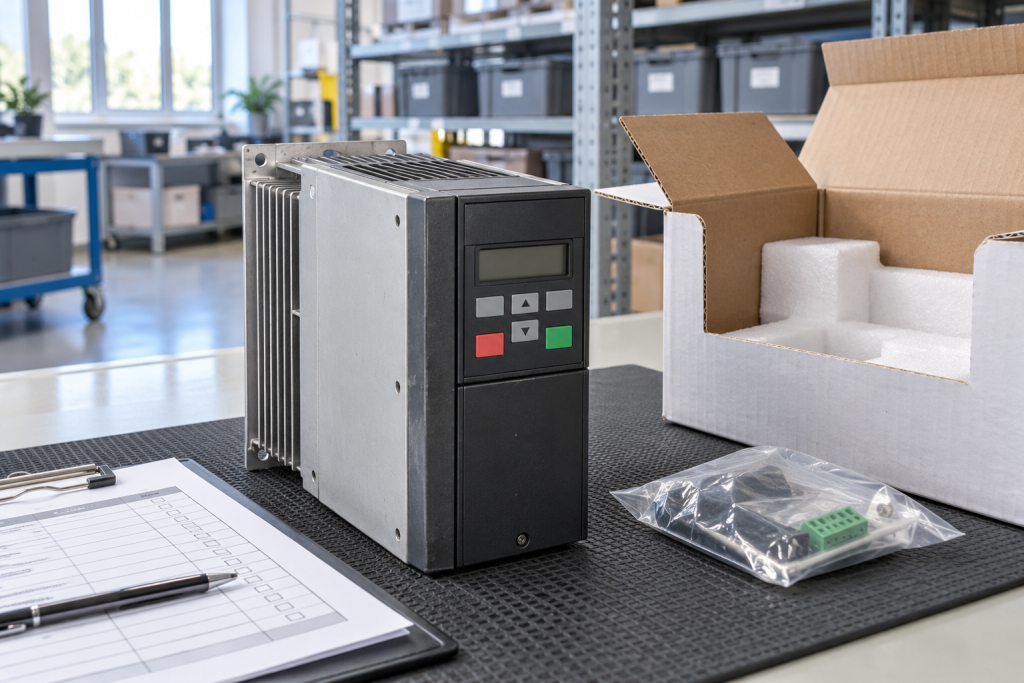
An unopened carton is evidence of packaging condition, not proof that a drive can be installed immediately. That distinction becomes important when an old production line depends on a VLT 2800 spare acquired years ago. The unit may have accumulated no operating hours while its storage history remains incomplete. Calling it unused answers a commercial question; it does not answer the maintenance team’s release-to-service question.
This is an evergreen receiving and stock-management issue, not a new Danfoss discontinuation announcement. The useful objective is to turn an uncertain spare into a documented decision: release it, send it for an appropriate assessment, or keep it unavailable until specific evidence is obtained.
Two descriptions that should never share one field
Keep commercial condition and technical readiness separate in the stock record. Commercial condition might be unused surplus, previously installed, repaired or otherwise documented by the supplier. Technical readiness might be awaiting inspection, assessed for a defined application, or reserved pending a service recommendation. Neither field should automatically populate the other.
A refurbishment record can contain more useful readiness evidence than a sealed box with no history. Conversely, a recent inspection does not erase the original condition or justify describing an older unit as newly manufactured. Preserve both facts. Engineers need the assessment scope; buyers need an accurate description of what they are purchasing.
Danfoss discusses the sensitivity of drive electronics, including electrolytic capacitors, to storage temperature in its guidance on drives and high temperatures. That is a reason to ask about storage exposure. It is not a universal calendar rule that every stored drive fails after a particular number of years.
Reconstruct the chain of custody
Start with the full nameplate rather than the family name alone. Capture the type code, electrical ratings, serial information and supplied options. Photograph the unit and its packaging without removing protective covers unnecessarily. Record whether the carton label agrees with the actual unit, and retain the photographs with the inventory entry.
Next build a simple timeline: original receipt if known, subsequent warehouse moves, periods outside controlled storage, service visits and the most recent documented assessment. Mark unknown periods as unknown. A guessed manufacturing date or an assumption that the previous owner stored it correctly creates false confidence.
A buyer considering a Danfoss VLT 2800 replacement drive should request these records against the exact offered unit. A family-level catalog page helps locate the requirement, but it cannot establish the rating, history or readiness of the specific item that will be shipped.
Use model-specific instructions, not a borrowed procedure
The VLT 2800 operating instructions distinguish storage conditions from operating conditions and document the product’s electrical and installation requirements. Check the manual revision and variant against the proposed unit. Guidance written for another drive family or enclosure should not be transferred simply because the manufacturer’s logo is the same.
Where storage duration or exposure raises concern, ask qualified service personnel for a model-specific assessment and any manufacturer-required conditioning procedure. This article deliberately does not prescribe a voltage ramp, capacitor measurement or energization sequence. Drive power circuits can retain hazardous energy, and an improvised test can damage hardware or put personnel at risk.
Do not use the production machine as the first test fixture for an uncertain spare. The approved assessment plan should define isolation, personnel competence, equipment and pass criteria. Any work involving hazardous voltage belongs under the site’s electrical safety procedures and the applicable manufacturer instructions.
Specify what the assessment actually demonstrated
A useful report identifies the tested unit, date, procedure and results. It separates inspection, startup checks and any functional or load-related assessment that was actually performed. A photograph of an illuminated keypad demonstrates far less than a documented test, but even a documented test has boundaries.
Ask what was not evaluated. Perhaps the assessment did not include the installed communication option, the intended duty cycle or behavior with the production motor. Those omissions are not automatically defects; they are tasks that must remain visible in the commissioning plan. Avoid compressing every outcome into a single unexplained word such as tested.
Release the spare for a named purpose. A unit may be suitable for further bench evaluation without being approved for production installation. Keep its parameter preparation and machine validation separate from the storage assessment so one completed activity does not accidentally authorize all the others.
Make the storeroom status useful during an outage
The inventory screen should show the assessment status, location of the evidence, responsible owner and next review trigger. Record whether required accessories are included. Reserve enough time for any outstanding service work before the planned outage; do not discover that requirement when the failed drive is already on the floor.
Review demand as the old line changes. A stored spare for a retired machine should not remain indefinitely in the emergency pool for another line without a fresh compatibility review. Likewise, a unit sent out for assessment should be marked unavailable rather than counted as immediate coverage. Accurate availability is more valuable than an inflated stock quantity.
Four practical questions
Does unused mean ready to install?
No. Unused describes reported service history. Readiness depends on identity, storage evidence, applicable assessment and acceptance for the intended installation. Record those decisions separately.
Should every stored VLT 2800 receive the same conditioning treatment?
Do not assume that. Obtain instructions appropriate to the exact product and its history from qualified service support. A procedure for a different drive family is not sufficient authority.
Can a supplier’s power-on video replace a test report?
It can supplement identification and show a limited observation, but it does not explain the test scope, conditions or acceptance criteria. Request a report that identifies the actual unit.
What if the storage history cannot be recovered?
Record the gap explicitly and agree an assessment route before release. Unknown history should change the decision process, not be quietly converted into a claim of good condition.
For a scoped quotation, send DriveKNMS the complete drive nameplate and required assessment scope, along with quantity and destination. Specify whether you need an identified hardware spare, documented evaluation, or both.
Image: AI-generated editorial illustration, not an exact product photograph or installation reference.
© 2026 DriveKNMS. All rights reserved. Official Website: https://driveknms.com Inquiry: sale@driveknms.com | WhatsApp/Tel: +86 18359293191