A DCS power-supply failure can look like a controller, I/O, or network failure because several racks lose visibility together. For a Yokogawa CENTUM installation, the spare plan must account for rack position, load, redundancy, alarm contacts, Vnet dependencies, and restart sequence. A power module on the shelf is useful only when the recovery path is understood.
DriveKNMS readers need a practical way to stage older DCS power and communication spares while operations continue. The best record links the power module to the rack and to the process evidence that must return after replacement.
Start with the rack power map
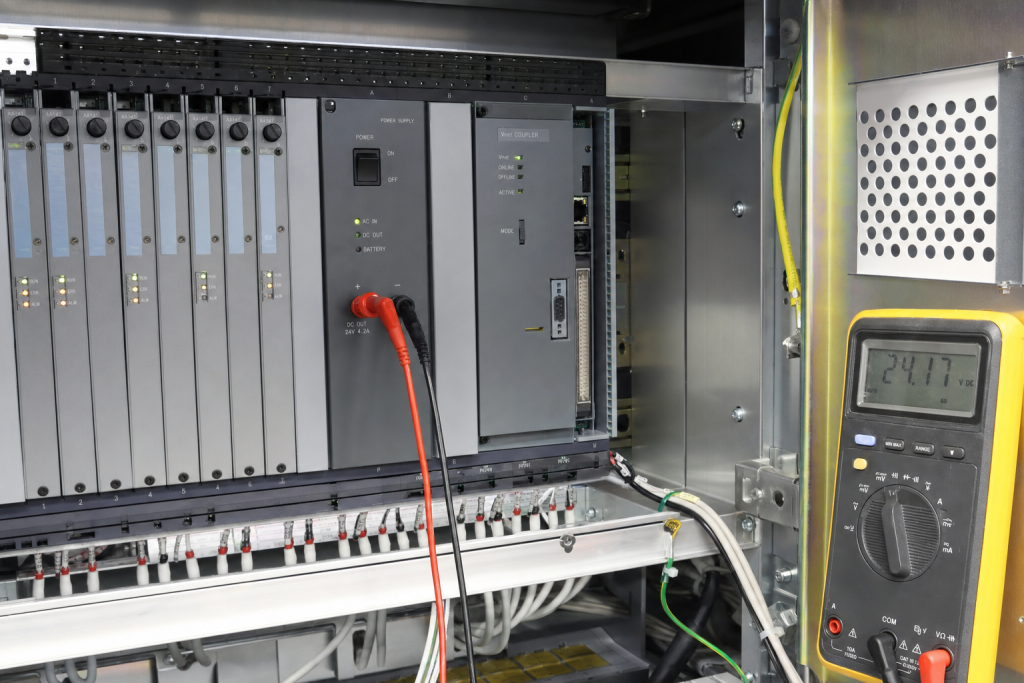
Record rack, slot, supply model, input and output, load, fuses, redundancy arrangement, alarm contact, adjacent controller and I/O, and the communication devices dependent on the supply.
The live Yokogawa SPW482-50 power supply reference is a catalog starting point. Compare it with the installed label, rack, terminals, output requirements, and condition evidence.
Photograph the supply label, terminals, rack position, wiring, protection, redundancy module, alarm contact, and adjacent Vnet equipment.
Separate power recovery from communication recovery
A new supply may restore voltage while a Vnet coupler, configuration, or restart order still prevents operator visibility. The Yokogawa VC401-10 Vnet coupler reference illustrates why communication dependencies should be recorded separately.
Confirm configuration backup, rack diagnostics, alarm behavior, and who owns the restart. Ask whether the RFQ requires hardware only, tested exchange, or commissioning support.
For surplus or refurbished items, request actual-item photos, terminal condition, test evidence, packaging, warranty, and accessory scope.
Acceptance should prove the DCS
After replacement, verify output under load, alarms, rack recognition, communication, representative I/O, operator displays, and the approved restart sequence.
Mark the item exact, conditional, bench-tested, or engineering review required. A powered module is not the same as recovered DCS service.
Save measured values, rack and cable photos, diagnostics, and the final test record. This keeps the next outage from becoming another open-ended search.
Build the RFQ around the installed function
A useful spare request begins with the installed function, not only a familiar brand name. State what the device does, where it sits, what it connects to, and what failure would stop or blind the process. Then add the exact label, revision, connector view, power information, accessory scope, condition requirement, destination, and required date. This gives procurement and engineering the same starting point.
Separate an exact replacement from a possible substitute, repair exchange, bench item, and migration candidate. These options may all be commercially useful, but they do not carry the same approval burden. An exact spare may support a short outage window. A substitute may need wiring changes, parameter review, software work, or a production trial before it can be counted as recovery stock.
The product references in this article are live catalog examples, not permission to skip engineering checks. Compare the product page with the installed label and the plant record. If a suffix, connector, voltage, protocol, firmware family, or mechanical interface differs, keep the item conditional until the responsible engineer closes that gap.
Receiving inspection should repeat the evidence used for the RFQ. Photograph the received label, packaging, connectors, terminals, mounting features, and included accessories. Record what was checked and what remains unknown. A clean-looking item is not automatically a field-ready spare, and an item that powers up is not automatically accepted by the control or protection function.
Keep the approved catalog and RFQ reference with the maintenance record, but do not let a catalog title replace the installed evidence. The useful record is the combination of model, function, interface, condition, test requirement, and decision owner.
Review the spare before the maintenance window, not only after a failure. Confirm that the item is still physically present, that packaging and accessories are intact, that the backup or test procedure is available, and that the responsible engineer is still named.
When a substitute is considered, write down the exact gap it is intended to close and the evidence needed to approve it. This may include a drawing comparison, firmware review, bench test, dimensional check, protection test, communication test, or production trial.
The final decision should be visible to stores, procurement, maintenance, and operations. Use plain status labels such as exact replacement, approved substitute, repair exchange, bench-only, or engineering review required.
FAQ
What should match on a CENTUM power supply spare?
Match model, rack, output, load, terminals, redundancy, alarms, condition, and restart requirements.
Can a Vnet coupler be treated as part of the power spare?
No. It is a separate communication dependency that should have its own model and acceptance checks.
What should an RFQ include?
Send rack and slot, supply label, wiring, load concerns, redundancy, alarms, condition, test scope, and deadline.
What proves DCS recovery?
Power under load, rack recognition, alarms, communication, representative I/O, operator visibility, and approved restart.
Send DriveKNMS your Yokogawa rack photos, SPW482-50 label, Vnet dependencies, load concerns, and deadline. We can help prepare a complete DCS recovery RFQ.
Before approval, record what the supplier cannot determine from a catalog page. Unknown firmware, missing drawings, unclear terminal scope, incomplete accessories, and untested condition should remain open items. This keeps the quote honest and gives engineering a short review list before the maintenance window.
A useful record also states what the supplier cannot determine from a catalog page. Unknown firmware, missing drawings, unclear terminal scope, incomplete accessories, and untested condition should be written as open items so the quote remains honest and the plant has a short list of questions to close before the equipment is needed.
© 2026 DriveKNMS. All rights reserved. Official Website: https://driveknms.com Inquiry: sale@driveknms.com | WhatsApp/Tel: +86 18359293191