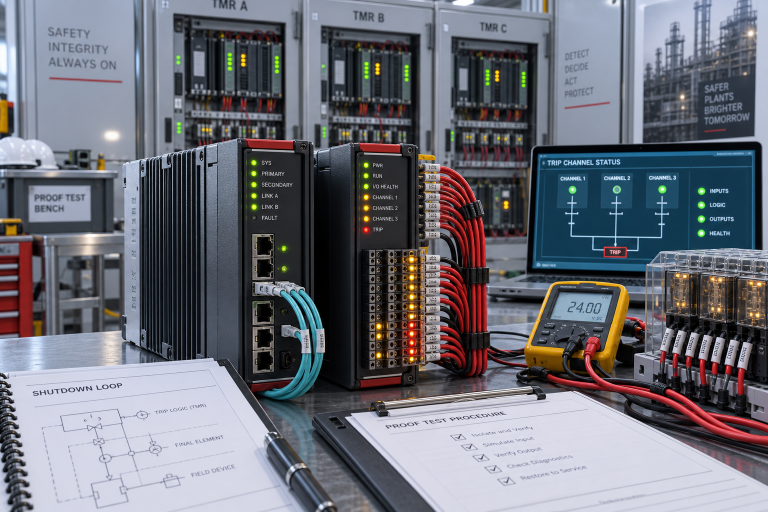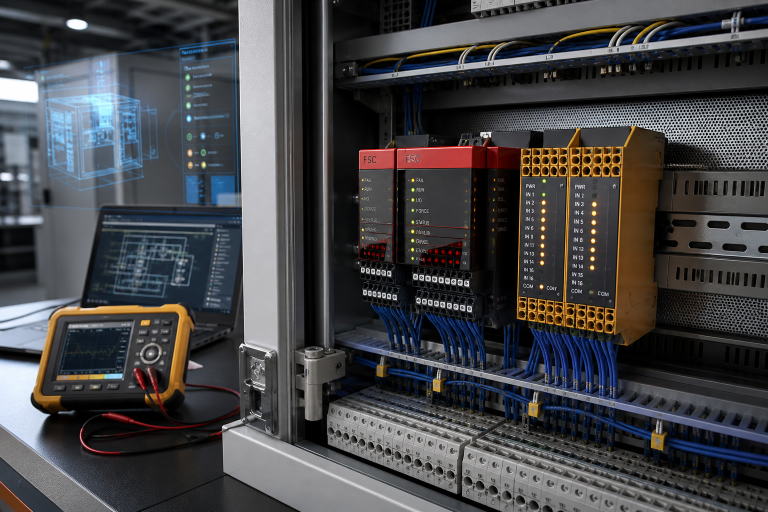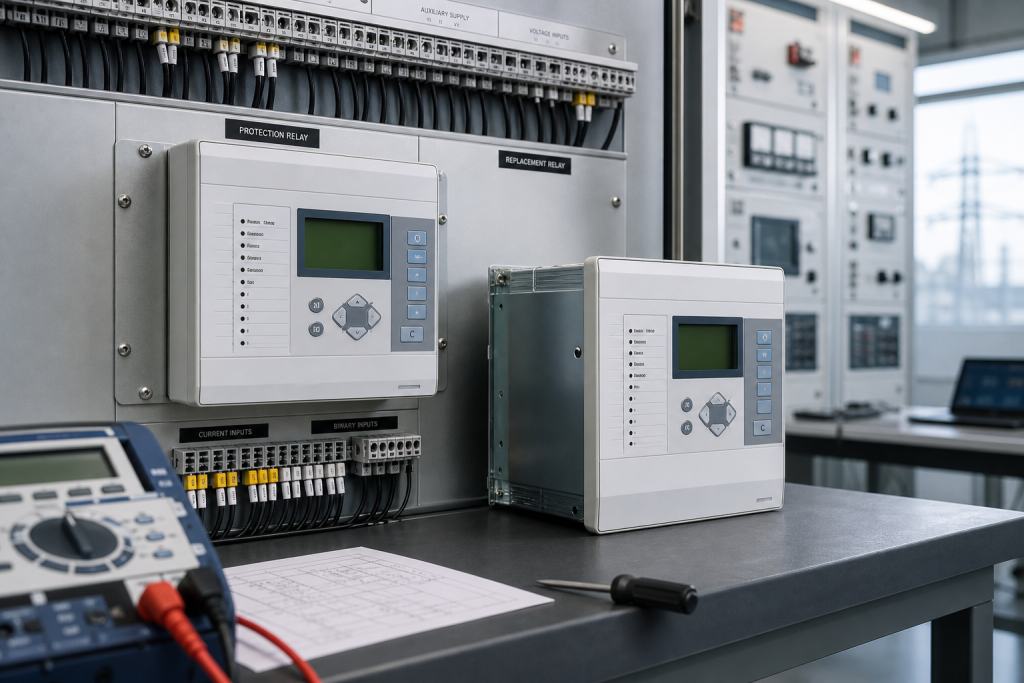
A protection relay replacement is not an ordinary control-module swap. The relay may sit between a measured fault and a trip decision, so the procurement record has to preserve the installed function, wiring, settings ownership, test method, and approval path. A close-looking front panel is not enough evidence for a safe replacement.
DriveKNMS readers often work across substations, motor protection panels, process plants, and remote electrical assets where the relay must be sourced quickly but commissioned carefully. The practical goal is to reduce the time between failure identification and a controlled, documented return to service.
Identify the relay function before the model
Record whether the relay protects a feeder, motor, transformer, generator, bus section, or another asset. Note CT and VT inputs, trip contacts, auxiliary contacts, communications, interlocking, and any external logic that depends on the device.
The catalog references for the ALSTOM MVAJ105RA0802A MiCOM-series relay and AREVA MVAJ101RA0802A module show why the exact label matters: brand history and series naming can vary across installed records.
Send clear photos of the relay face, side label, terminal strip, rear connector, panel cutout, and adjacent wiring. Include the protection drawing reference without exposing unnecessary sensitive network information.
Preserve settings and test ownership
Before removing a failed relay, confirm whether settings, event records, logic, and communication configuration are backed up. A hardware replacement without the correct settings file can restore a display while leaving the protection function incomplete.
Define who owns secondary injection testing, trip-circuit checks, CT/VT polarity confirmation, time synchronization, and operations release. Procurement should know whether the quote needs a tested unit, engineering support, or only hardware.
Separate exact replacement, repair exchange, and substitute options in the RFQ. A substitute can be valuable, but it may require a protection study, wiring changes, new software, or a planned outage longer than the original failure response.
Acceptance must include the protection chain
After installation, check terminal mapping, auxiliary contacts, communication, settings, alarms, trip path, and the approved test record. A relay that boots is not necessarily a relay that protects the asset correctly.
Mark the spare as field-ready only when the plant has accepted the relevant test evidence. Bench power-up or visual inspection should be recorded as a lower-confidence status.
Keep the final relay label, settings reference, test results, and approved quote together. The next emergency should begin with known evidence rather than an old product description.
Build the RFQ around the installed function
A useful spare request begins with the installed function, not only a familiar brand name. State what the device does, where it sits, what it connects to, and what failure would stop or blind the process. Then add the exact label, revision, connector view, power information, accessory scope, condition requirement, destination, and required date. This gives procurement and engineering the same starting point.
Separate an exact replacement from a possible substitute, repair exchange, bench item, and migration candidate. These options may all be commercially useful, but they do not carry the same approval burden. An exact spare may support a short outage window. A substitute may need wiring changes, parameter review, software work, or a production trial before it can be counted as recovery stock.
The product references in this article are live catalog examples, not permission to skip engineering checks. Compare the product page with the installed label and the plant record. If a suffix, connector, voltage, protocol, firmware family, or mechanical interface differs, keep the item conditional until the responsible engineer closes that gap.
Receiving inspection should repeat the evidence used for the RFQ. Photograph the received label, packaging, connectors, terminals, mounting features, and included accessories. Record what was checked and what remains unknown. A clean-looking item is not automatically a field-ready spare, and an item that powers up is not automatically accepted by the control or protection function.
Keep the approved catalog and RFQ reference with the maintenance record, but do not let a catalog title replace the installed evidence. The useful record is the combination of model, function, interface, condition, test requirement, and decision owner. That combination remains valuable even when the next supplier uses a different description for the same hardware family.
Review the spare before the maintenance window, not only after a failure. Confirm that the item is still physically present, that packaging and accessories are intact, that the backup or test procedure is available, and that the responsible engineer is still named. Small changes in wiring, software ownership, or cabinet layout can make an old spare conditional without anyone updating the shelf record.
When a substitute is considered, write down the exact gap it is intended to close and the evidence needed to approve it. This may include a drawing comparison, firmware review, bench test, dimensional check, secondary injection test, communication test, or production trial. A short approval checklist is easier to review than a vague statement that the substitute is equivalent.
The final decision should be visible to stores, procurement, maintenance, and operations. Use plain status labels such as exact replacement, approved substitute, repair exchange, bench-only, or engineering review required. Clear status prevents a useful but conditional item from being pulled as if it were already approved for a live plant function.
FAQ
What information is essential for a MiCOM relay RFQ?
Provide exact model, function, terminal and connector photos, CT/VT role, settings status, communications, condition preference, and outage timing.
Can an AREVA-labeled relay replace an ALSTOM-labeled unit?
Only after engineering confirms the exact series, hardware, firmware, wiring, settings, and protection approval path.
Does a replacement include settings?
Not automatically. Confirm whether the plant has a backup and who will load, review, and test it.
What proves the relay is ready for service?
Approved wiring, settings, trip and alarm checks, communication checks, and the required protection test record.
Send DriveKNMS the relay label, terminal photos, protection role, settings status, and deadline. We can help separate hardware sourcing from the engineering checks that make the replacement usable.
© 2026 DriveKNMS. All rights reserved. Official Website: https://driveknms.com Inquiry: sale@driveknms.com | WhatsApp/Tel: +86 18359293191