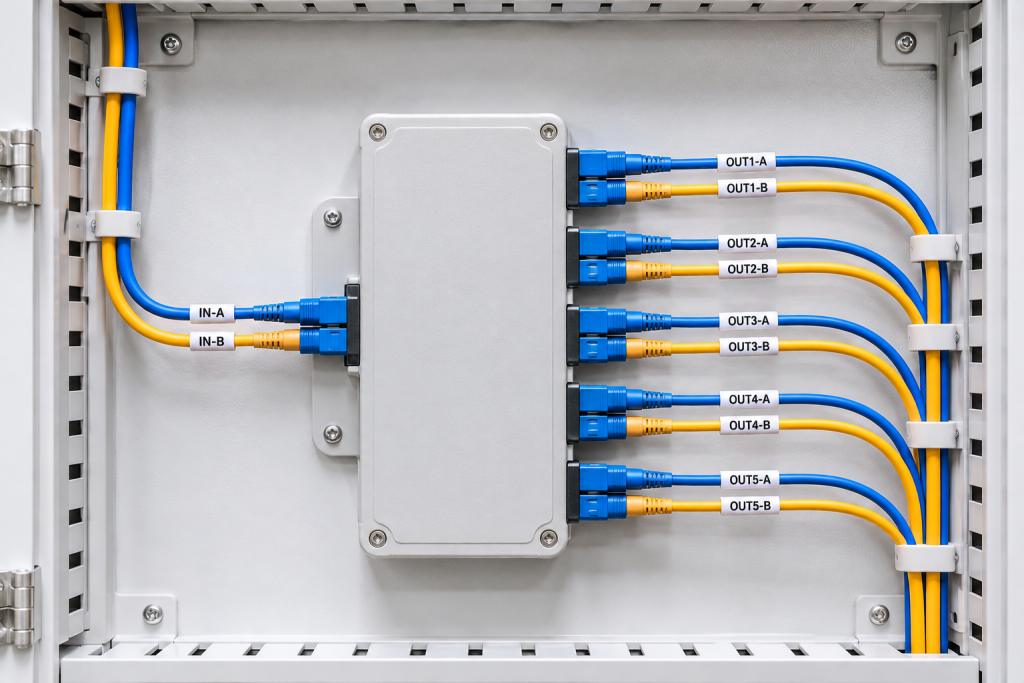
A DDCS communication fault can appear to implicate several drives at once, even when the useful evidence is concentrated around one branching unit or optical path. Before ordering an NDBU spare, preserve the physical branch map. A list of drive addresses alone does not tell a technician which optical pair reaches which cabinet, which port is upstream, or which equipment was intentionally unavailable during the last test.
This is an engineering preparation guide for existing DDCS installations, not a new product announcement or a universal replacement procedure. Work on the actual system remains subject to its approved drawings, drive documentation, isolation requirements and change-control process.
What the branching unit does, and what it does not prove
ABB’s DCS880 hardware manual describes the NDBU-95 as a means of forming a star topology for DDCS communication. It distinguishes a master connection from the downstream channels and explains the advantage of avoiding a communication chain that depends on every connected converter remaining powered. This architectural reference is not approval to fit every NDBU variant to every ABB drive.
The star layout gives the maintenance team a useful way to organize observations. An issue confined to one downstream branch should be recorded differently from an issue affecting all branches. Neither observation alone proves which component has failed. Shared supply, the upstream connection, configuration and the test conditions still matter. Treat the pattern as a way to focus investigation, not as permission to replace hardware by elimination on a running machine.
Build the map before the labels disappear
A practical branch map can fit on one drawing sheet. Give the branching unit a unique cabinet identifier. Record each occupied channel and the destination equipment tag. Keep the transmit and receive identification exactly as documented for the installed hardware; do not rely on jacket color as the sole authority. Record unused channels explicitly so an empty position is not mistaken for a missing cable.
Add the full unit identity, revision information available on its label, supply reference and the document that defines its application. Include photographs that show port orientation as well as close views of labels. A close-up can identify a connector beautifully while making it impossible to determine whether the photograph was taken from the front or rear of the assembly.
Store the drawing with the maintenance work package, not only on an individual laptop. Where the approved layout differs from the observed layout, create a discrepancy entry. Do not quietly redraw the approved arrangement to match an unexplained field change. The useful deliverable is a reviewed relationship between physical branches and system functions.
Keep NDBU-95 and NDBU-95C identification explicit
If the installed label calls for an ABB NDBU-95C DDCS branching unit, include that complete identity in the inquiry. A shortened description such as optical hub is not enough to establish the correct spare. Provide the host drive family and the system drawing so the offered hardware can be evaluated in its actual application.
The separate NDBU-95 product reference is useful when that is the documented requirement, but the similarity of the names does not establish unrestricted interchangeability. Ask for identification photographs and evidence relevant to the quoted item. Keep any proposed alternative as a separate engineering review rather than treating the suffix as an optional purchasing abbreviation.
Likewise, do not translate the branch map into Ethernet terminology merely because both systems use communication cables. DDCS topology, hardware and application requirements must be assessed from their own documentation. A generic network-switch test report does not demonstrate that an optical DDCS branching unit is suitable for the intended service.
Design acceptance around the intended branches
Before an approved isolated test, define which endpoints are expected, which are deliberately absent and what evidence will count as success. Keep a record of the upstream equipment, downstream identities and test configuration. Otherwise, an apparently healthy test may simply have exercised a different branch arrangement from the one that will be used on the machine.
The acceptance record should distinguish physical identification, communication observations and application behavior. A visible indication on the unit is one observation, not a substitute for confirming the intended endpoint. Record anomalies without immediately assigning blame to the replacement. The same symptom may reflect a damaged cable, an incorrect connection or a configuration mismatch outside the supplied component.
Do not demonstrate branch independence by disconnecting operational equipment during production. Any deliberate loss-of-communication test needs an approved test environment or outage plan, with the machine response assessed in advance. The sourcing team can help gather item identity and test evidence; authorization for machine behavior belongs to the plant.
Make the handover usable for the next shift
Package the final branch map with the accepted hardware identity, date, test scope and unresolved limitations. Include the old unit’s disposition and the state in which the spare is returned to storage. A unit that has passed a limited bench check should not acquire a broader claim merely because it receives a new stores label.
For a DriveKNMS inquiry, provide the exact NDBU marking, the host application and a clear photograph of the branch arrangement. Ask the quotation to identify the supplied unit and the available evidence. That small preparation makes a replacement discussion more precise and gives the maintenance engineer something more useful than an unqualified statement that the unit powers up.
Frequently Asked Questions
Is an NDBU branching unit an Ethernet switch?
No. Assess it within the documented DDCS architecture. Similar-looking cabling or a generic communications description does not establish protocol or application equivalence.
Does one failed branch prove that the branching unit is faulty?
No. It identifies a useful investigation boundary. The endpoint, optical pair, connection identity and configuration must also be considered under an approved diagnostic plan.
Can an NDBU-95C automatically replace an NDBU-95?
Do not assume so from the name. Verify the complete item identity against the installed application and obtain appropriate manufacturer or engineering confirmation for any substitution.
What is the minimum useful RFQ attachment?
Provide a readable unit label and a branch map identifying the upstream connection and downstream destinations. Add the host equipment identity and relevant drawing revision.
Image: AI-generated editorial illustration, not an exact product photograph or installation reference.
© 2026 DriveKNMS. All rights reserved. Official Website: https://driveknms.com Inquiry: sale@driveknms.com | WhatsApp/Tel: +86 18359293191