
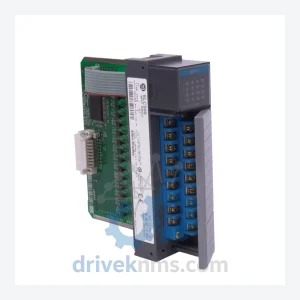
Allen-Bradley 1746-IO12 Combination I/O Module – Obsolete SLC 500 Spare Part
Allen-Bradley 1746-IO12 is listed for SLC 500 RFQ review. Confirm quantity, condition and destination before quotation.
RFQ-ready industrial model
Model: 1734-OE2C/B
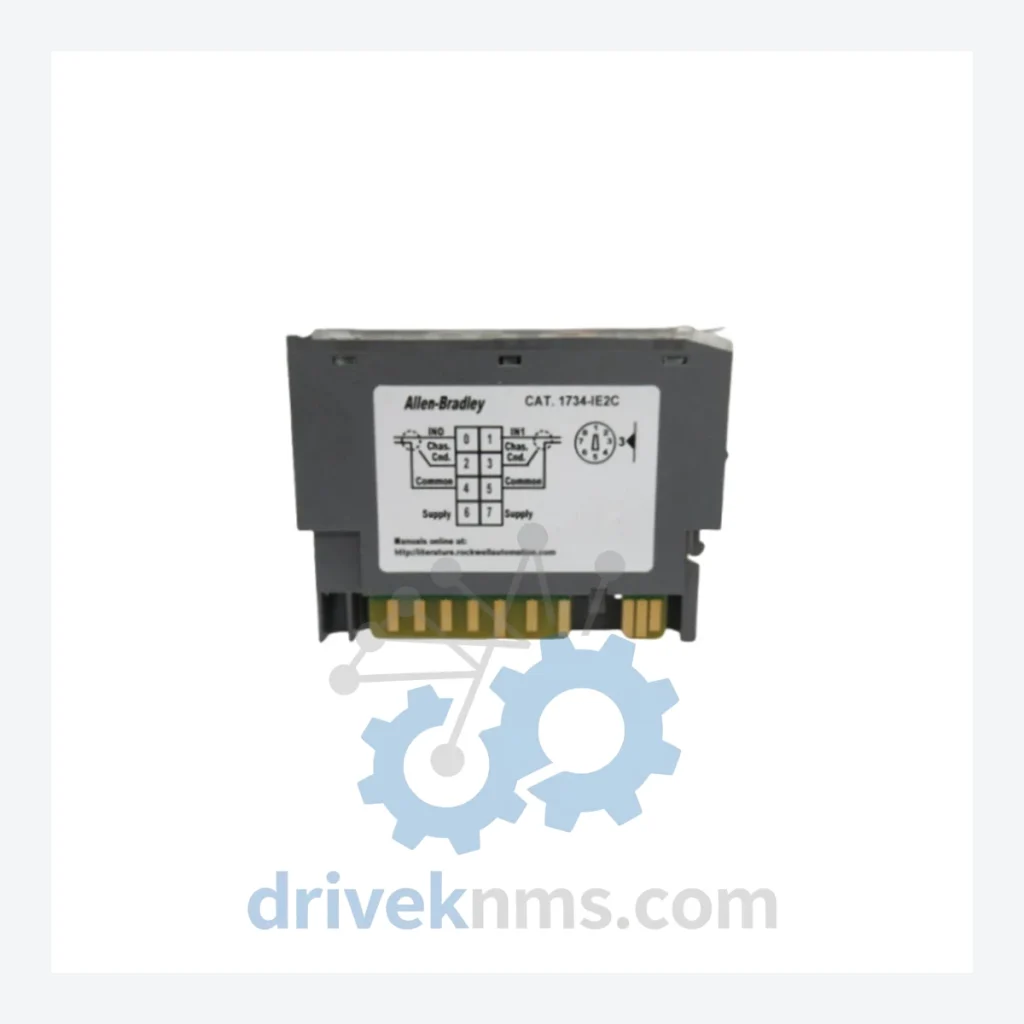
Product Overview
Commercial availability is handled through direct RFQ, model verification and export-oriented follow-up rather than public cart checkout.
Datasheet Preview
Use attached product manuals when available. If the manual is not public yet, request the full file directly through RFQ.
Commercial Path
Product pages on DRIVEKNMS are designed to verify model, brand and series first, then move the buyer into one clean quotation path.
Technical Dossier
The Allen-Bradley 1734 POINT I/O series is a modular, distributed I/O platform developed by Rockwell Automation. It is deployed across heavy industrial sectors including petrochemical refineries, nuclear power auxiliary systems, offshore oil & gas platforms, pulp and paper mills, and large-scale water treatment facilities. The system's defining characteristic is its single-slot, single-channel architecture, which allows engineers to configure I/O density at the point level rather than at the card level — minimizing unused channel waste and reducing panel footprint in safety-critical installations. The 1734 platform communicates natively over EtherNet/IP, DeviceNet, ControlNet, and PROFIBUS DP via dedicated adapter modules, making it compatible with the full Allen-Bradley Logix controller family (ControlLogix, CompactLogix, SoftLogix) as well as legacy PLC-5 and SLC 500 systems through appropriate gateway configurations. Global installed base for the 1734 series spans tens of thousands of active nodes across process industries, and the platform remains a primary specification in brownfield expansion projects where existing POINT I/O infrastructure must be extended rather than replaced.
The 1734 POINT I/O platform was introduced in the late 1990s as Rockwell Automation's response to the growing demand for distributed, granular I/O in process control. The first-generation modules used a proprietary backplane bus with a dedicated POINT I/O adapter (e.g., 1734-ADNX for DeviceNet) and supported basic digital and analog I/O functions. Early revisions (Series A) had limited diagnostic capability and required manual configuration via DIP switches on the terminal base.
The Series B revision introduced electronic keying, which allows the controller to verify module identity at startup and flag mismatches — a critical feature for safety-regulated environments. Series C and later revisions added extended temperature ratings (–25°C to +70°C for select modules), improved EMC shielding, and expanded the catalog to include specialty modules such as HART-enabled analog inputs, SSI encoder interfaces, and IEC 61131-3 configurable I/O.
With the widespread adoption of EtherNet/IP in the 2010s, Rockwell released the 1734-AENTR dual-port EtherNet/IP adapter, enabling Device Level Ring (DLR) topology for fault-tolerant network architectures. This adapter became the de facto standard for new 1734 installations and is backward-compatible with all existing 1734 I/O modules. The platform's modular terminal base system (1734-TB, 1734-TBS, 1734-TBCJC) has remained dimensionally consistent across all generations, ensuring that module replacements do not require rewiring of field terminations — a key factor in the platform's longevity in brownfield sites.
As of 2026, the 1734 series is in a mature lifecycle phase. Rockwell Automation continues to manufacture and support the full catalog, but engineers specifying new greenfield installations are increasingly directed toward the 1734-EP24DC (expanded power) and Compact 5000 I/O platforms for higher-density applications. For existing 1734 installations, long-term spare parts availability is the primary operational concern.
Analog Output Modules
Analog Input Modules
Digital Output Modules
Digital Input Modules
Communication Adapters
Power & Infrastructure
Each 1734 module processed by DriveKNMS undergoes a structured inspection and functional test protocol before dispatch. The procedure addresses the specific failure modes documented for the POINT I/O platform: backplane connector wear (pins 1–8 on the module base connector are inspected under 10× magnification for deformation or oxidation); terminal base locking tab integrity (a common mechanical failure point on high-cycle installations); and internal bus communication verification using a live 1734-AENTR adapter and a CompactLogix test rack running RSLogix 5000 / Studio 5000 Logix Designer.
Analog modules (including the 1734-OE2C/B) are tested against published accuracy specifications: output linearity is verified across the full 0–20 mA and 0–10 VDC ranges using a calibrated Fluke 754 Documenting Process Calibrator. Modules that fail to meet ±0.1% full-scale accuracy are quarantined and not dispatched. Digital modules are tested for correct channel switching, diagnostic bit reporting, and electronic fuse reset behavior. All test results are logged and available to customers on request.
Continue The Model Path
Move from this exact model into the matching system hub, brand archive, model-family archive or lifecycle sourcing route before sending a final RFQ list.
Related Paths
Allen-Bradley 1746-IO12 is listed for SLC 500 RFQ review. Confirm quantity, condition and destination before quotation.
Allen-Bradley 1746-ITV16 is listed for SLC 500 RFQ review. Confirm quantity, condition and destination before quotation.
Allen-Bradley 1746-OV32 is listed for SLC 500 RFQ review. Confirm quantity, condition and destination before quotation.