Technical Dossier
Product Details And Specifications
Mitsubishi FR-A500 Series Technical Notes
The Mitsubishi Electric FR-A500 series represents one of the most widely deployed variable frequency drive (VFD) platforms in global heavy industry. Installed across petrochemical refineries, nuclear power auxiliary systems, cement plants, steel rolling mills, and offshore platforms, the FR-A500 series established Mitsubishi Electric's position as a tier-1 supplier of industrial drive technology. Its modular PCB architecture — including control boards, gate driver boards, power supply boards, and interface cards — enabled field-level repair and component-level maintenance, a critical requirement for facilities operating under continuous-process constraints where full drive replacement is operationally impractical.
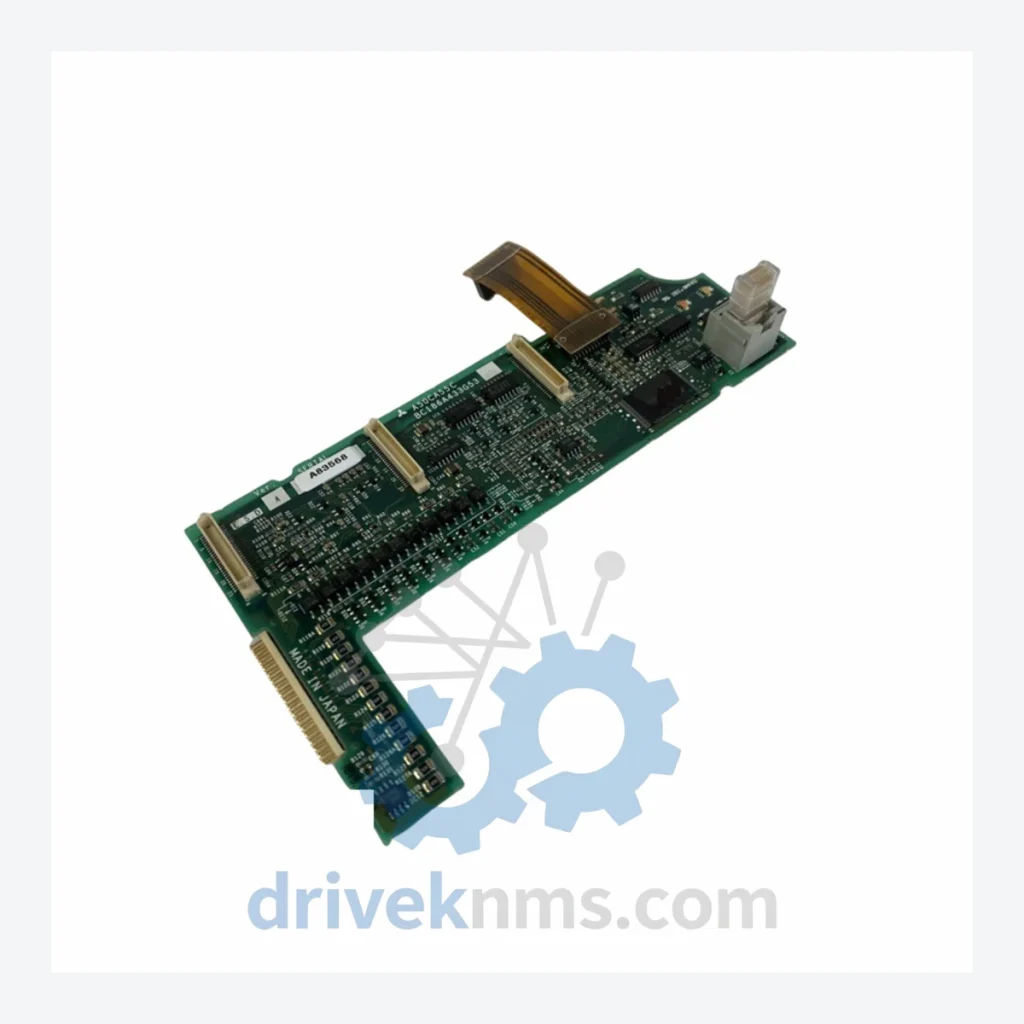
The A50CA55C BC186A433G53 is a factory-original inverter board (gate driver / power interface PCB) designed for use within the FR-A500 series drive platform. It serves as the interface layer between the control logic and the IGBT power module stack, managing gate signal conditioning, fault feedback, and DC bus monitoring functions.
The Evolution of FR-A500 Architecture
Mitsubishi Electric introduced the FR-A500 series in the early 1990s as a successor to the FR-A200 and FR-A300 platforms. The A500 generation introduced vector control without encoder feedback (sensorless vector), a significant advancement over the V/f-only control of its predecessors. The internal architecture was organized around a modular PCB stack: a main control board (CPU/DSP layer), a gate driver board (the inverter board layer, of which the A50CA55C BC186A433G53 is a representative component), a power supply board, and an optional communication interface card.
The FR-A500 series was succeeded by the FR-A700 series (introduced circa 2006–2008), which adopted a 32-bit DSP core, enhanced EMC filtering, and a revised power module layout incompatible with A500-generation PCBs. This architectural discontinuity means that A500-series boards — including the A50CA55C BC186A433G53 — cannot be cross-substituted with A700-generation components. Facilities still operating FR-A500 drives must source original or equivalent A500-series PCBs for repair.
The FR-A500 series entered end-of-production status, with Mitsubishi Electric formally discontinuing new unit manufacturing. Spare parts availability through the OEM channel has progressively declined, making third-party specialist suppliers the primary sourcing channel for boards such as the A50CA55C BC186A433G53.
FR-A500 Full Catalog & Functionalities (SKU List)
The following SKUs represent verified components associated with the Mitsubishi FR-A500 series drive platform, organized by functional category:
Inverter / Gate Driver Boards
- A50CA55C BC186A433G53: Gate driver / inverter interface PCB for FR-A500 series; manages IGBT gate signal conditioning and DC bus fault feedback.
- A50CA55C BC186A433G52: Earlier revision of the A433G53 gate driver board; functionally equivalent with minor component-level differences.
- A50CA55C BC186A433G51: First-generation gate driver board for mid-frame FR-A500 drives; predecessor to G52/G53 revisions.
- A50CA55C BC186A433G54: Later revision gate driver board; verify drive nameplate compatibility before substitution.
Main Control / CPU Boards
- A50CA55C BC186A432G52: Main control PCB for FR-A500 series; hosts DSP, parameter memory, and analog/digital I/O interface logic.
- A50CA55C BC186A432G53: Revised main control board with updated firmware ROM; direct replacement for G52 in most applications.
- FR-A5NC: CC-Link communication option card for FR-A500 series; enables network integration with Mitsubishi MELSEC PLC systems.
- FR-A5AP: Encoder feedback option card (pulse train input); enables closed-loop vector control on FR-A500 drives.
Power Supply Boards
- A50CA55C BC186A431G52: Switched-mode power supply PCB for FR-A500 series; provides regulated DC rails to control and gate driver boards.
- A50CA55C BC186A431G53: Revised SMPS board; check capacitor date codes on aged units prior to installation.
Interface / I/O Boards
- FR-A5AX: Extended terminal option board; adds additional analog input channels and relay output contacts.
- FR-A5AL: Remote operator link option; enables remote keypad panel connection for FR-A500 drives.
- FR-A5NR: PROFIBUS-DP communication option card for FR-A500 series.
- FR-A5ND: DeviceNet communication option card for FR-A500 series.
- FR-A5NM: Modbus RTU communication option card for FR-A500 series.
- FR-DU04: Digital operator panel (keypad) compatible with FR-A500 series drives; parameter programming and fault display interface.
- FR-PU04: Parameter unit for FR-A500 series; handheld programming and monitoring device.
Quality Control for the FR-A500 Range
All FR-A500 series PCBs processed by DriveKNMS undergo a structured inspection and functional verification protocol prior to dispatch. For inverter boards such as the A50CA55C BC186A433G53, the test sequence includes: visual inspection for physical damage, burnt components, and PCB trace integrity; in-circuit resistance measurement across gate driver output stages; optocoupler isolation testing; capacitor ESR measurement on all electrolytic capacitors; and functional power-up verification under controlled bench conditions using a compatible FR-A500 drive chassis. Boards exhibiting marginal ESR values or degraded optocoupler transfer ratios are either reconditioned or rejected. Each dispatched unit is accompanied by a test record and is shipped in anti-static packaging with appropriate mechanical protection.