Technical Dossier
Product Details And Specifications
Mitsubishi FX3U Series Technical Notes
The Mitsubishi Electric MELSEC FX3U series represents the third-generation compact PLC platform within the FX family, engineered for high-speed processing, expanded I/O capacity, and flexible communication architecture. Deployed across global heavy industry sectors — including petrochemical refineries, nuclear auxiliary systems, automotive assembly lines, and offshore platform control — the FX3U platform has accumulated an installed base spanning several hundred thousand units worldwide. Its 32-bit RISC CPU architecture, 64K-step program memory, and support for up to 384 I/O points (with extension) position it as the benchmark compact controller for mid-complexity automation tasks. The series supports simultaneous multi-protocol communication via its left-side expansion bus, accommodating RS-232C, RS-485, USB, Ethernet, PROFIBUS-DP, CC-Link, and DeviceNet adapters without consuming main I/O slots.
The Evolution of FX3U Architecture
The FX lineage originates with the FX0/FX0N series (early 1990s), which established Mitsubishi's compact PLC market position with fixed I/O configurations and basic ladder logic execution. The FX1S and FX1N series introduced modular expansion capability and analog I/O support, while the FX2N (released circa 1998) became the dominant platform for the following decade, offering 8K-step memory and a broad special function module ecosystem. The FX3U (introduced 2004–2005) superseded the FX2N with a 64K-step memory ceiling, built-in USB port, 3-axis independent pulse output at 100kHz, and a high-speed counter input rated to 200kHz. The left-side communication board slot — occupied by modules such as the FX3U-485-BD — was a structural departure from the FX2N's right-side special module bus, enabling communication expansion without consuming I/O extension slots.
The FX3UC variant introduced a connector-type terminal block for space-constrained installations. The FX3G and FX3GE followed as cost-optimized derivatives sharing the FX3U instruction set. As of 2020, Mitsubishi Electric announced the FX5U series (MELSEC iQ-F) as the designated successor platform, with the FX3U series entering a managed lifecycle phase. Spare parts and replacement modules for FX3U remain in active demand across installed-base maintenance contracts, particularly in facilities with 10–20 year equipment replacement cycles.
FX3U Full Catalog & Functionalities (SKU List)
Communication Board Modules (Left-Side Expansion Slot)
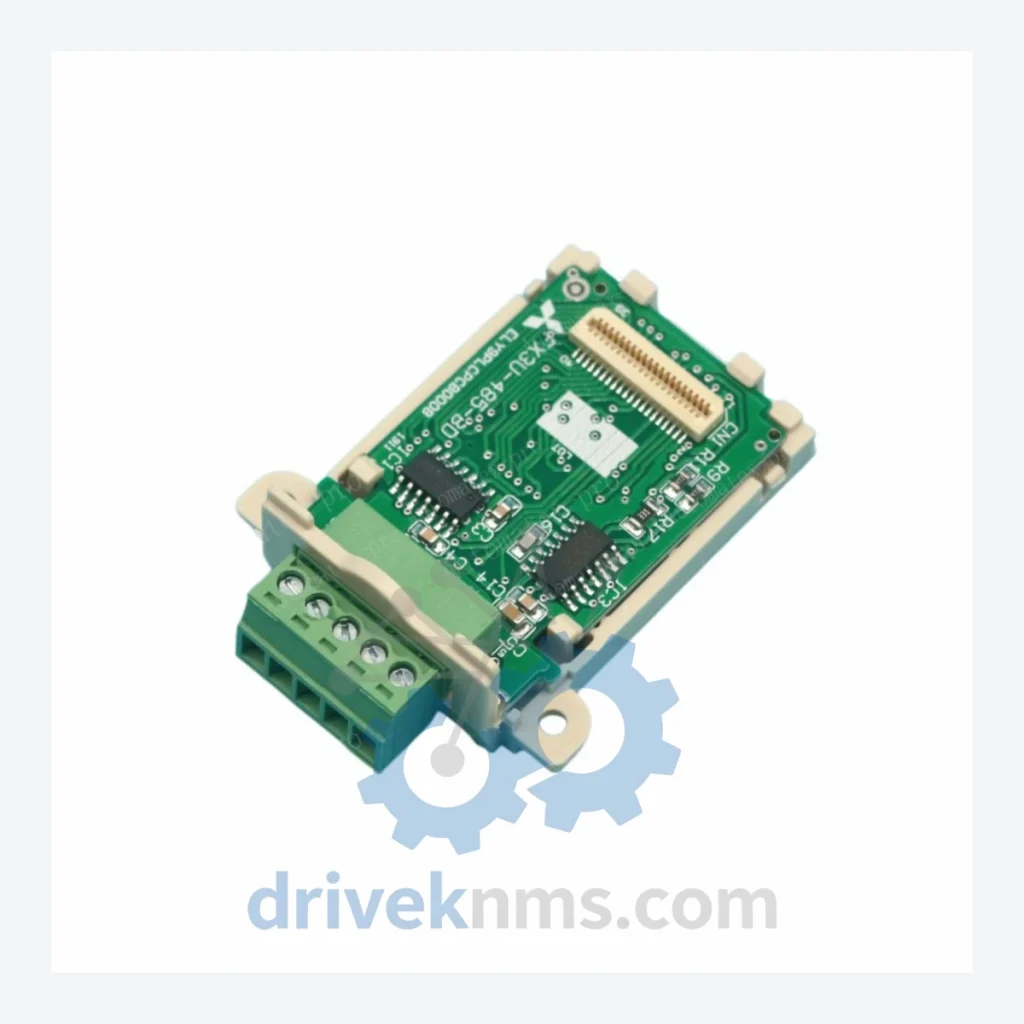
- FX3U-485-BD: RS-485 half-duplex serial communication board; supports MODBUS RTU, inverter protocol, N:N network; max 50m cable distance per segment.
- FX3U-232-BD: RS-232C full-duplex serial board; used for HMI, barcode scanner, and PC-link communication; D-sub 9-pin connector.
- FX3U-USB-BD: USB mini-B programming and monitoring interface board; replaces SC-09 cable requirement; plug-and-play with GX Works2/3.
- FX3U-422-BD: RS-422 communication board; dedicated for programming port expansion and GOT HMI direct connection.
- FX3U-CNV-BD: Conversion board enabling FX2N-series special function modules to connect to FX3U left-side bus; critical for legacy system integration.
Ethernet & Network Adapter Modules
- FX3U-ENET: 100BASE-TX Ethernet module; supports MELSOFT connection, MC protocol, and socket communication; up to 16 simultaneous connections.
- FX3U-ENET-L: Ethernet module with CC-Link IE Field Basic support; enables integration into iQ-R/iQ-F network topologies.
- FX3U-64CCL: CC-Link Ver.2 master/slave module; supports up to 64 stations; 10Mbps transmission rate.
- FX3U-16CCL-M: CC-Link master module; controls up to 16 remote I/O stations; used in distributed I/O architectures.
- FX3U-PROFIBUS-DP: PROFIBUS-DP slave module; enables FX3U integration into Siemens and third-party PROFIBUS master networks.
Analog I/O Special Function Modules
- FX3U-4AD: 4-channel analog input module; 12-bit resolution; supports ±10V, 0–10V, 4–20mA input ranges; scan time 15ms/4ch.
- FX3U-4DA: 4-channel analog output module; 12-bit resolution; voltage and current output; used in PID loop control and valve positioning.
- FX3U-4AD-PT: 4-channel PT100 RTD temperature input module; -200°C to +600°C range; 0.1°C resolution.
- FX3U-4AD-TC: 4-channel thermocouple input module; supports K, J, T, E, R, S, B type thermocouples; cold junction compensation built-in.
- FX3U-2HSY-ADP: 2-axis high-speed synchronous output adapter; 200kHz pulse output; used in servo and stepper motor positioning.
Digital I/O Extension Modules
- FX3U-16EX: 16-point DC24V sink/source input extension module; expands base unit digital input capacity.
- FX3U-16EYT: 16-point transistor (source) output extension module; 0.5A per point; suitable for high-speed output applications.
- FX3U-16EYR: 16-point relay output extension module; 2A per point; used for motor starters and solenoid valve control.
- FX3U-32ET: 32-point mixed I/O extension block (16 inputs / 16 transistor outputs); compact form factor for panel space optimization.
Quality Control for the FX3U Range
FX3U communication boards and special function modules undergo a structured verification protocol prior to dispatch. Each unit is bench-tested using a reference FX3U-32MR/ES base unit with GX Works2 diagnostic software. Communication boards (including the FX3U-485-BD) are tested for RS-485 signal integrity, termination resistance continuity, and protocol handshake completion under MODBUS RTU and N:N network configurations. Analog modules are calibrated against traceable reference standards with channel-by-channel linearity verification across the full input/output range. Backplane connector pins are inspected under magnification for oxidation, mechanical deformation, and solder joint integrity. Units exhibiting parameter drift beyond Mitsubishi's published tolerance specifications are quarantined and not released for sale.