Technical Dossier
Product Details And Specifications
Mitsubishi MR-J3 Series Technical Notes
The Mitsubishi Electric MR-J3 series servo amplifiers represent one of the most widely deployed motion control platforms in global heavy industry. Installed across petrochemical refineries, nuclear power auxiliary systems, automotive stamping lines, steel rolling mills, and pharmaceutical packaging facilities, the MR-J3 platform established a benchmark for high-response AC servo control when it entered production in the early 2000s. Its SSCNET III fiber-optic network architecture enabled deterministic, noise-immune communication between the controller and drive axes — a critical requirement in high-EMI environments such as arc furnace facilities and large-scale CNC machining centers. The series spans output ratings from 50W to 22kW, covering single-axis standalone configurations and multi-axis synchronized systems. As of 2026, the MR-J3 series has entered its end-of-life phase, with Mitsubishi Electric having transitioned the product line to the MR-J4 and MR-J5 successor platforms. However, installed base volumes in legacy systems remain substantial, and demand for MR-J3 spare parts and replacement units continues across maintenance, repair, and overhaul (MRO) channels globally.
The Evolution of MR-J3 Architecture
The MR-J3 series succeeded the MR-J2S platform, introducing SSCNET III (Servo System Controller Network III) as its primary communication backbone — a 150 Mbps full-duplex optical network replacing the earlier RS-422-based SSCNET II. This transition eliminated wiring-induced noise issues that had been a persistent challenge in the MR-J2S generation, particularly in multi-axis configurations exceeding 16 axes.
Early MR-J3 variants (circa 2004–2007) supported only SSCNET III connectivity and required dedicated Mitsubishi motion controllers (Q172D, Q173D series). Mid-generation firmware revisions introduced enhanced auto-tuning algorithms (One-touch tuning, adaptive vibration suppression filter) that reduced commissioning time significantly on machines with mechanical resonance characteristics. The MR-J3-B sub-series added SSCNET III/H compatibility preparation, while the MR-J3-A sub-series provided pulse-train input for integration with third-party controllers.
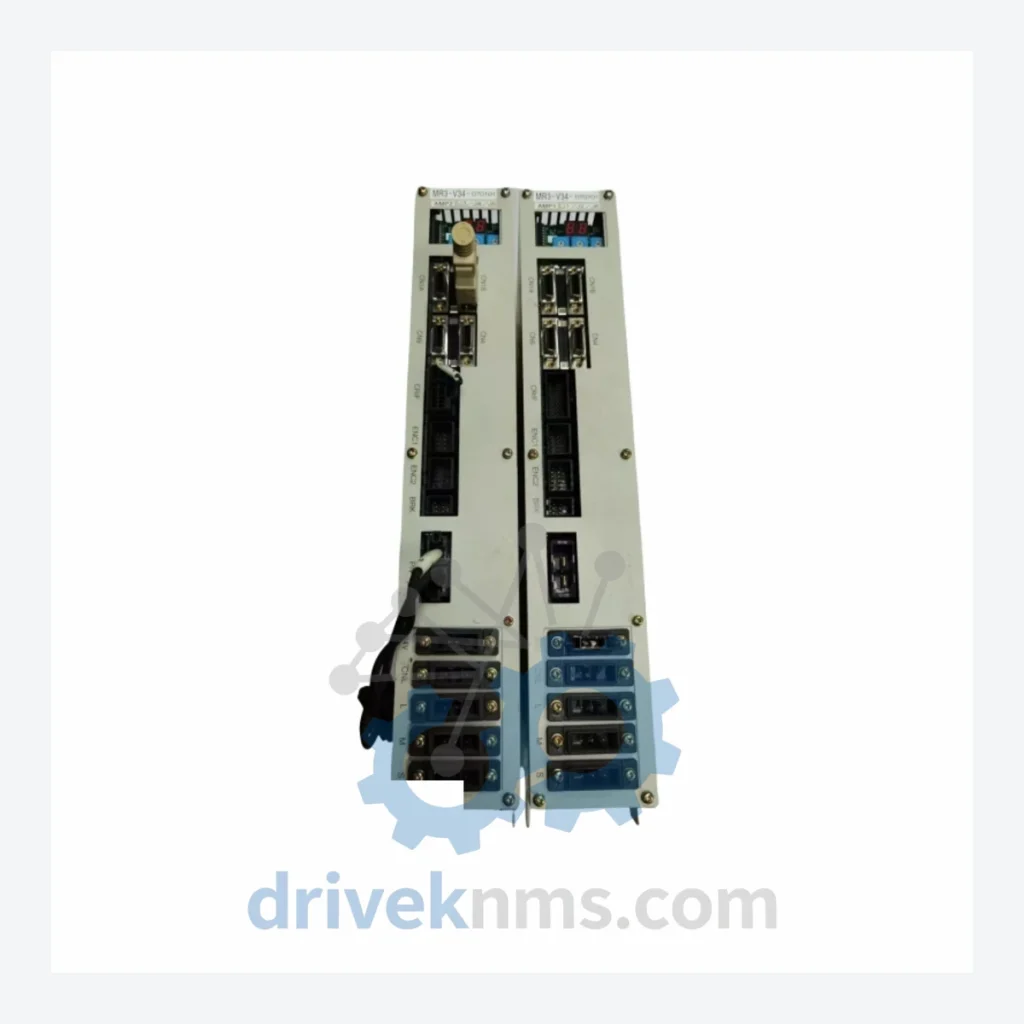
The MR3-V34-070701 unit (the subject SKU of this listing) is a factory-configured or revision-specific variant within the MR-J3 platform, identifiable by its V34 firmware/hardware revision designation and 070701 date/lot code. Compatibility with standard MR-J3 accessories (MR-A-TM terminal block, MR-BT6V battery unit, MR-J3ENCBL encoder cables) is maintained.
Successor migration path: MR-J3 → MR-J4 (SSCNET III/H, enhanced safety STO function) → MR-J5 (EtherCAT/CC-Link IE TSN, IEC 61800-5-2 SIL2). Cross-generation mechanical mounting dimensions are largely preserved, but connector pinouts and parameter sets require re-mapping during upgrades.
MR-J3 Full Catalog & Functionalities (SKU List)
The following SKUs represent the core MR-J3 series range. All units are AC servo amplifiers unless otherwise noted. Output capacity is indicated in the model suffix (e.g., 10 = 100W, 70 = 700W, 350 = 3.5kW).
SSCNET III Bus-Type Amplifiers (MR-J3-□B)
- MR-J3-10B: 100W SSCNET III servo amplifier, single-phase 200–230VAC input, for small-axis positioning.
- MR-J3-20B: 200W SSCNET III amplifier, compact form factor, suitable for conveyor indexing axes.
- MR-J3-40B: 400W SSCNET III amplifier, standard DIN-rail or panel mount, general-purpose motion axis.
- MR-J3-70B: 700W SSCNET III amplifier, mid-range torque output, common in multi-axis gantry systems.
- MR-J3-100B: 1.0kW SSCNET III amplifier, three-phase 200VAC, high-cycle duty applications.
- MR-J3-200B: 2.0kW SSCNET III amplifier, three-phase input, used in rotary table and spindle-assist axes.
- MR-J3-350B: 3.5kW SSCNET III amplifier, heavy-duty axis control for press and injection molding machines.
- MR-J3-500B: 5.0kW SSCNET III amplifier, large-frame unit, suitable for main drive axes on machining centers.
- MR-J3-700B: 7.0kW SSCNET III amplifier, high-inertia load applications, steel processing lines.
- MR-J3-11KB: 11kW SSCNET III amplifier, three-phase 200VAC, large servo axis for heavy industrial equipment.
- MR-J3-15KB: 15kW SSCNET III amplifier, high-power axis, used in rolling mill and winding machine drives.
- MR-J3-22KB: 22kW SSCNET III amplifier, maximum capacity in the standard MR-J3-B range.
Pulse-Train Input Amplifiers (MR-J3-□A)
- MR-J3-10A: 100W pulse-train input amplifier, compatible with third-party PLCs and CNC controllers.
- MR-J3-40A: 400W pulse-train input amplifier, differential line driver or open-collector pulse input.
- MR-J3-70A: 700W pulse-train input amplifier, standard positioning axis for non-Mitsubishi controller systems.
- MR-J3-200A: 2.0kW pulse-train input amplifier, used in retrofit applications replacing older analog servo drives.
- MR-J3-350A: 3.5kW pulse-train input amplifier, high-torque axis with full parameter configurability via MR Configurator.
Revision / Lot-Specific Variants
- MR3-V34-070701: MR-J3 platform unit with V34 hardware/firmware revision, lot code 070701. Functionally equivalent to standard MR-J3-B series; revision suffix indicates factory configuration or production batch designation. Verify compatibility with existing SSCNET III network topology before installation.
Sourcing Hard-to-Find & Obsolete MR-J3 Parts
Customers operating legacy systems with no near-term upgrade budget are advised to establish a strategic spare inventory of critical MR-J3 axis amplifiers. DriveKNMS can assist with site-level BOM analysis to identify which axis ratings are most critical and most difficult to source, enabling a prioritized procurement strategy.
Quality Control for the MR-J3 Range
The MR-J3 series presents specific quality control challenges due to its SSCNET III optical transceiver circuitry, high-frequency PWM power stage, and encoder feedback processing board. DriveKNMS applies the following test protocol to all MR-J3 units prior to shipment:
- Visual inspection of power module (IGBT/IPM) for thermal stress, solder joint fatigue, and capacitor bulge.
- Optical transceiver continuity and signal integrity test on SSCNET III CN1A/CN1B ports using calibrated fiber loopback fixtures.
- DC bus capacitance measurement against factory specification (capacitance degradation >20% from nominal is cause for rejection).
- Functional power-on test with motor load simulation: encoder signal verification, current loop response, and alarm code readout via MR Configurator2 software.
- Parameter default restore and firmware version logging prior to packaging.
- Final burn-in cycle at rated load for a minimum of 2 hours to screen for latent component failures.