“We need a filter for the drive” sounds like a complete request until the quotation arrives. The cabinet may need an incoming EMC line filter, an input reactor, or a motor-side solution for a different electrical problem. These devices can appear in the same installation and still serve different purposes. Selecting one because its current rating looks familiar can leave the original problem untouched.
For PowerFlex 525 maintenance, the first question is therefore not which filter is cheapest or available fastest. It is where the proposed part belongs in the power path, what problem it is intended to address, and which installation requirements apply. This is a maintenance and spare-identification discussion, not a new discontinuation announcement.
Trace the path before comparing catalog numbers
Draw the installation as supply, incoming equipment, drive, motor cable and motor. Place every existing accessory on that drawing using the actual cabinet documentation. A photograph of a metal enclosure without its connections is insufficient because several different accessories can look similar from the outside.
Rockwell identifies the 25-RF7P5-AL as a PowerFlex 520 EMC filter kit. Its product cut sheet specifies the supply class, current and frame association. Those are identifying facts, not a promise that adding the item will make an arbitrary cabinet compliant.
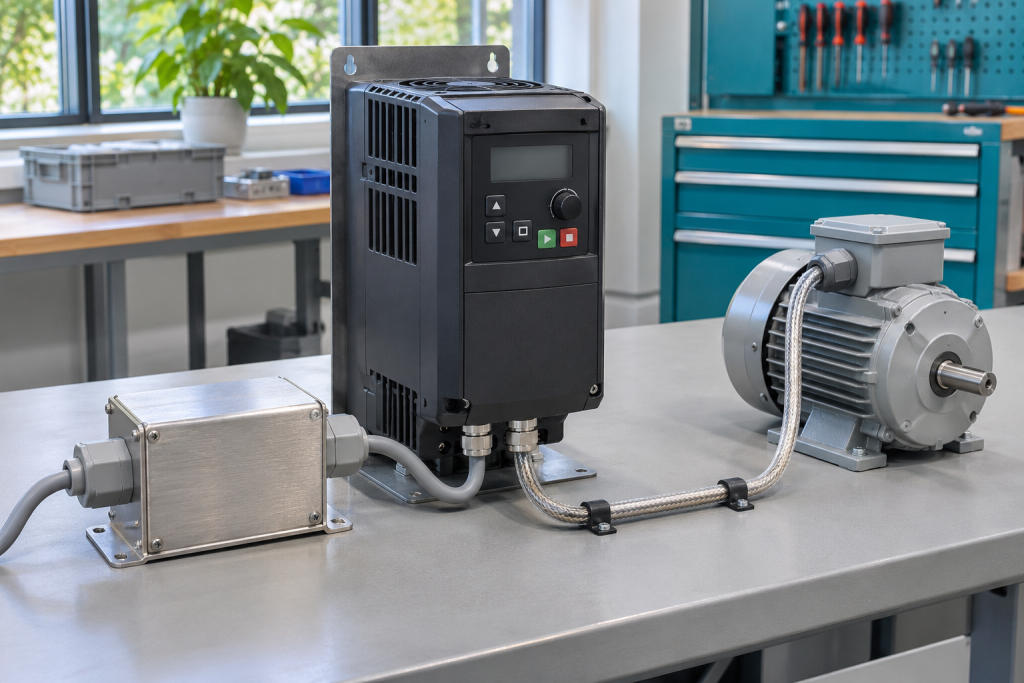
An incoming EMC filter is not the same thing as a motor-side filter. Likewise, a reactor and an EMC filter should not be treated as synonyms. If the complaint concerns motor insulation, bearing damage, nuisance interference or an incoming supply condition, those observations need engineering interpretation before a spare can be selected. The symptom alone does not prove which accessory failed.
The spare must match an installation, not just a motor
When requesting a 25-RF7P5-AL EMC line-filter spare, provide the existing filter label and the full drive catalog number. Include the supply arrangement and the drawing reference that locates the filter. This makes it possible to identify the requested part without implying it is a universal answer for every drive carrying the PowerFlex name.
Rockwell’s Bulletin 160 to PowerFlex 525 migration guide includes separate EMC filter selections for different drive ratings and frame sizes. Use the applicable documentation for the actual configuration. Motor output current by itself does not describe all the selection conditions on the incoming side.
If the drive is also being replaced, identify it separately. An inquiry for a PowerFlex 525 25B-D6P0N114 drive should retain the installed unit’s complete code and option details. Do not infer an approved drive-and-filter combination simply because two catalog pages appear together in an article. The configuration review remains a separate step.
What changed when the interference appeared?
A useful troubleshooting record begins with changes, not a shopping list. Did the problem start after a cabinet rebuild, a motor replacement, a cable reroute, a bonding repair or a change to nearby instrumentation? Was the same symptom present before the most recent drive exchange? These questions help distinguish a failed component from an installation that was altered around a healthy one.
Record when the symptom occurs: continuously, during acceleration, at a particular operating condition, or only when another machine runs. Preserve existing diagnostic records and the affected instrument’s observations. Avoid repeatedly replacing the drive simply because its operation coincides with the disturbance. Coincidence can be a clue, but it is not a confirmed failure mechanism.
A qualified electrical specialist should assess bonding, cable routing, shielding and the manufacturer’s installation requirements. Do not disconnect protective earth, defeat protection or improvise a filter connection to see whether a symptom disappears. Any investigation involving hazardous voltage belongs under the site’s isolation, competence and electrical safety procedures.
Make the purchasing boundary explicit
A clear RFQ can ask for an exact identified replacement without asking the supplier to redesign the cabinet. State whether the request is identification only, supply of an approved part, or an engineering review that has not yet been completed. These are different scopes, and confusion between them can produce a technically incomplete quotation.
Include photographs of all labels, mounting features and connectors, taken safely under the site’s procedures. Note whether brackets, fasteners or other accessories are required. A quote for the electrical item alone may be commercially correct but still leave the maintenance team without the hardware needed for its planned outage.
Keep lifecycle status separate from the condition of an individual spare. A distributor description containing the word “obsolete” is not, by itself, an OEM lifecycle notice. Ask for the applicable manufacturer evidence before changing the site’s replacement strategy. Similarly, a published product page does not prove present stock, lead time or acceptance for a particular installation.
Close the work order with the original complaint
Receiving the correct part closes the purchasing question; it does not close the maintenance problem. The approved return-to-service plan should revisit the original observation and document the result under comparable operating conditions. Where formal EMC evidence is required, a successful production run is not a substitute for that evidence.
Update the equipment record only after the authorized configuration is confirmed. Store the removed item’s identity and the reason for its disposition. An unexplained replacement that happens to make a symptom disappear should remain an investigation finding, not become an unsupported rule for every similar cabinet.
Frequently asked questions
Will an EMC line filter protect any motor from drive output stress?
No such general conclusion follows from its name. Incoming EMC filtering and motor-side protection have different functions. The motor, cable, drive and intended protection measure need their own engineering assessment.
Can I select the filter using motor kilowatts alone?
No. Establish the exact drive, incoming supply, accessory type and applicable selection table. A motor rating does not identify the complete installation or all the conditions attached to a filter selection.
Does a matching filter prove the whole cabinet meets EMC requirements?
No. Compliance depends on the applicable requirements and the completed installation. The correct component is only one part of that assessment; wiring, bonding and configuration also matter.
What should I send with a replacement inquiry?
Send the filter and drive nameplates, supply details, drawing reference, required accessories and a concise description of the fault. Mark any uncertainty explicitly so identification is not confused with approval of a redesign.
DriveKNMS can review an inquiry against the requested part identity and supply scope. Send the full codes and documentation needed for your outage, and ask for a quote that clearly states condition, included accessories and available supporting evidence.
Image: AI-generated editorial illustration, not an exact product photograph or installation reference.
© 2026 DriveKNMS. All rights reserved. Official Website: https://driveknms.com Inquiry: sale@driveknms.com | WhatsApp/Tel: +86 18359293191