Rockwell Automation is using PACK EXPO International 2026 to show a practical route toward more autonomous operations: keep proven control infrastructure, then add data, software, robotics, and digital-twin capabilities in stages. That message matters to maintenance teams because the first modernization risk is rarely the new dashboard. It is the old drive cabinet that no one has documented well enough to recover after a failure.
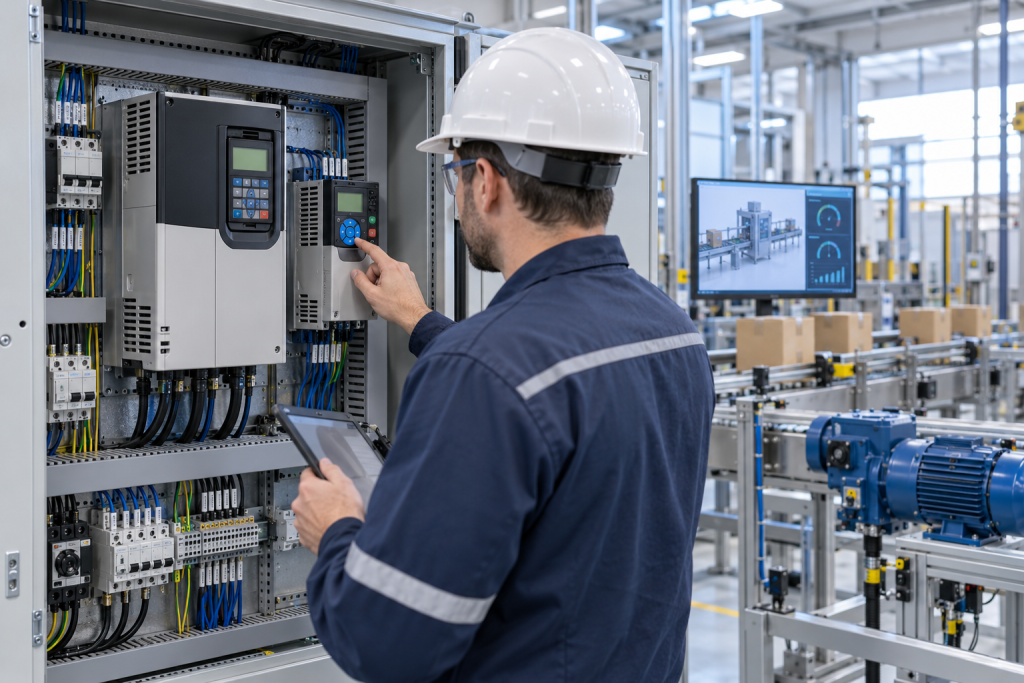
A PowerFlex drive can sit at the boundary between production mechanics, electrical protection, motion behavior, safety logic, and plant data. When the drive is replaced without preserving that boundary evidence, a “successful” installation can still create nuisance trips, incorrect acceleration, lost diagnostics, or a machine that runs but no longer behaves like the validated process. Digitalization works better when the drive baseline is controlled first.
Start With The Drive’s Real Role
Record the machine, motor, load, duty cycle, speed reference, braking method, safety function, network connection, and the process consequence of losing the drive. Capture the complete catalog number, option code, firmware, keypad or HIM details, installed parameters, terminal wiring, and the exact status of every fault indicator. A family name such as PowerFlex 750 is not enough to identify the right recovery part.
Take photographs before disconnecting anything. Include the nameplate, terminal strip, control board, field wiring, network module, surrounding power components, and the relationship between the drive and motor. Save the parameter file and note whether the backup was taken from the live drive, a commissioning archive, or an older engineering workstation.
Modernization Does Not Excuse Weak Parameters
An autonomous-operations roadmap may introduce new analytics, edge devices, or digital-twin models, but the deterministic drive layer still needs stable parameters. Record motor data, ramp times, current limits, overload class, carrier frequency, braking settings, loss-of-load behavior, safe torque off behavior, and the source of the speed command. If a value is plant-specific, say so instead of copying a generic factory default into the recovery record.
The Allen-Bradley PowerFlex 755 20F11NC022JA0NNNNN is a useful example of why exact configuration matters. The correct question is not simply whether it is a 755 drive. It is whether the voltage, power, option structure, control method, feedback arrangement, firmware family, and application parameters match the installed machine and its approved recovery plan.
Keep Safety And Motion Evidence Separate
Drive modernization projects often combine production performance and safety objectives, but those records should remain distinguishable. A speed improvement, a new network connection, or a control algorithm update does not by itself prove that a safety function is preserved. Identify the safety relay or controller, the safe torque off channels, the reset behavior, the guard circuit, and the validation method before and after a drive change.
The Allen-Bradley 20-750-S torque-off module belongs in that safety evidence chain, not in a generic drive accessory list. The RFQ and test plan should state the exact drive frame, terminal arrangement, safety circuit, required proof test, and the person responsible for accepting the result.
Use A Staged Digitalization Sequence
A low-risk sequence has four stages. First, freeze the as-found state and make a verified parameter backup. Second, prove the direct recovery path with the existing motor, load, safety circuit, and network. Third, add monitoring or edge data collection without changing the control command path. Fourth, make an approved control or optimization change only after the plant has baseline trends and a rollback plan.
This order helps maintenance distinguish a drive failure from a data integration problem. If a new edge gateway, dashboard, or digital-twin connection appears at the same time as a drive swap, a poor test sequence can make a communication issue look like a motor or inverter fault. Keep each change observable and reversible.
What To Ask For In A Drive RFQ
Specify the complete part number, voltage class, power rating, frame, option cards, feedback interface, safety module, firmware constraints, acceptable condition, quantity, and delivery date. Add the motor nameplate, application duty, fault history, parameter backup, photos, and whether the supplier must provide a test report or exchange option. State whether a refurbished unit is acceptable and what evidence is required before installation.
For a modernization project, ask the supplier to quote recovery hardware separately from future-state hardware. A direct spare may be needed this week, while a newer architecture will be engineered over months. Separating those decisions protects uptime without allowing a temporary part to become an undocumented permanent solution.
Return-To-Service Checks
After installation, verify insulation and power conditions, motor rotation, parameter readback, direction command, reference scaling, acceleration and deceleration, current draw, fault history, network diagnostics, and safety response. Run the machine through representative load conditions, not only an unloaded jog. Compare speed, torque, current, and temperature with the saved baseline.
Once the machine is stable, update the installed record with the new serial number, firmware, parameter file, safety validation, and image set. That record is what makes the next digitalization step safer. Without it, the next engineer begins with the same uncertainty that caused the original delay.
FAQ
Does a digital-twin project require replacing every PowerFlex drive?
No. A staged project can collect data from existing drives first. Replacement should be driven by lifecycle, condition, compatibility, performance, or safety requirements rather than by the presence of a new analytics layer.
Why are PowerFlex option codes important in an RFQ?
Option cards and firmware can determine feedback, communications, safety, and application behavior. A base family match can still be unusable when the installed option structure is different.
Can the drive be tested without the production motor?
A bench check can prove basic power-up and selected functions, but it cannot replace a controlled plant test of motor data, load behavior, safety circuits, and network command paths.
What should be backed up before a drive replacement?
Save parameters, firmware information, fault history, wiring and terminal photos, motor data, safety documentation, network settings, and the as-found operating behavior.
Request a quote: Send drive labels, motor data, fault codes, parameter files, option cards, quantity, condition requirement, destination, and outage timing to driveknms. This lets the sourcing team distinguish a direct recovery spare from a modernization component.
© 2026 DriveKNMS. All rights reserved. Official Website: https://driveknms.com Inquiry: sale@driveknms.com | WhatsApp/Tel: +86 18359293191